
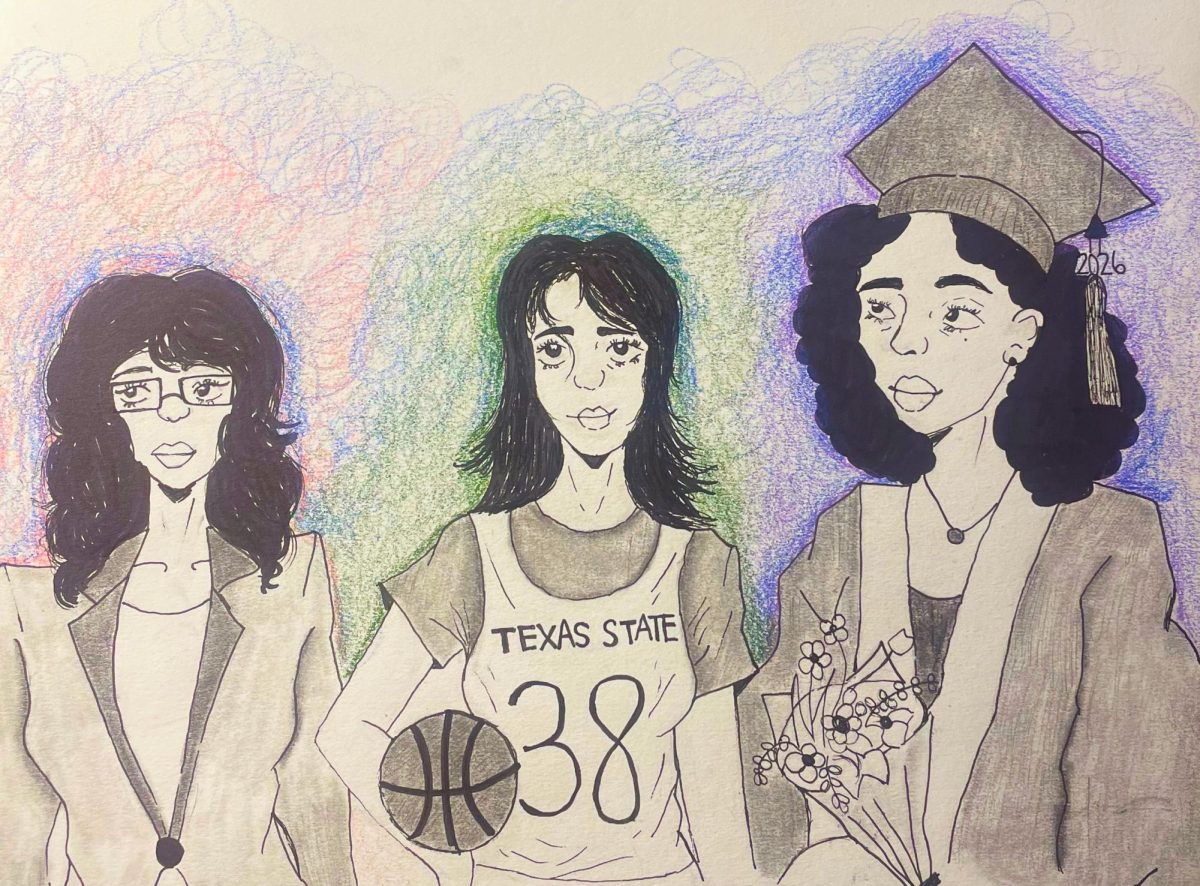
March marks Women’s History Month, which is meant to honor women’s contributions in society. However, when celebrating the accomplishments of women, many ignore the challenges they still face today. If March is meant to uplift women’s achievements, acknowledging their setbacks is just as important.
Women have a long history at Texas State, dating all the way back to the university’s early years. Throughout the school’s history, women still faced obstacles and barriers preventing them from the same achievements of their male counterparts. Even now, women continue to face similar challenges in their education.
These hurdles were finally acknowledged through legislative efforts seemed to be the only way to combat it. In 1972, as part of the Education Amendments, Title IX was enacted to prohibit sex-based discrimination, but like all legislation Title IX isn’t perfect. That is why awareness is so important, especially at Texas State, as people are tasked to make up for the law’s shortcomings.
Title IX is key for allowing women’s sports, giving new opportunities for funding and allowing for more recognition. At Texas State, women’s sports have existed since 1903, and often have higher success rates than other teams. However, supporting these teams goes beyond just March, as their success empowers women everywhere.
Megan Webb, assistant director of women’s volleyball, softball and basketball, said supporting women’s sports programs is one of the highlights of her job.
“I’m surrounded by incredible women all day, every single day, and it’s such a privilege,” Webb said. “It’s such an honor to get to be a part of that, and that’s the biggest thing. And that doesn’t end in March.”
Supporting women’s sports can make a significant difference. After years of ignoring outrage, the WNBA has finally agreed to pay their athletes more, allowing their work to be appreciated to the same standard as their male counterparts in the NBA. This same sentiment can be applied to universities, with support paving the way to new opportunities.
By uplifting women’s voices year-round, women can also be appreciated in more than just sports. The same barriers that many women face in sports also exist in their education.
Allison Robinson, director of women’s gender and sexuality studies, said women have often been excluded, forcing them to work even harder to be noticed.
“Women have constantly had to carve out a space for themselves,” Robinson said. “Often overworking, just to prove that they belong there.”
As of 2025, about 53% of faculty are classified as women according to employee data in Data, Analytics & Institutional Research at Texas State. Despite being the majority at Texas State, women’s academic accomplishments are often not as valued as men’s due to gender sterotypes. For example only seeing women as nurses instead of doctors only further harms their perceptions in society. As women work to carve out their place, it often seems like society has already decided it for them.
This is especially prevalent in women-led research and publications. According to the National Library for Medicine, women are credited far less than men in science. As Texas State pushes for R1 status, it cannot push its women out.
While Women’s History Month ends in March, the struggles women face don’t. Women should be celebrated, but oftentimes the acknowledgment of barriers placed before them is even more impactful. These challenges aren’t exclusive to Texas State and are ingrained into society, but in order to truly foster change that has be recognized every day, all year round.