
Editor’s Note: The original version of this article incorrectly reported that city staff preferred the downtown City Hall site. This has since been corrected to show that the New City Hall Steering Committee preferred the site.
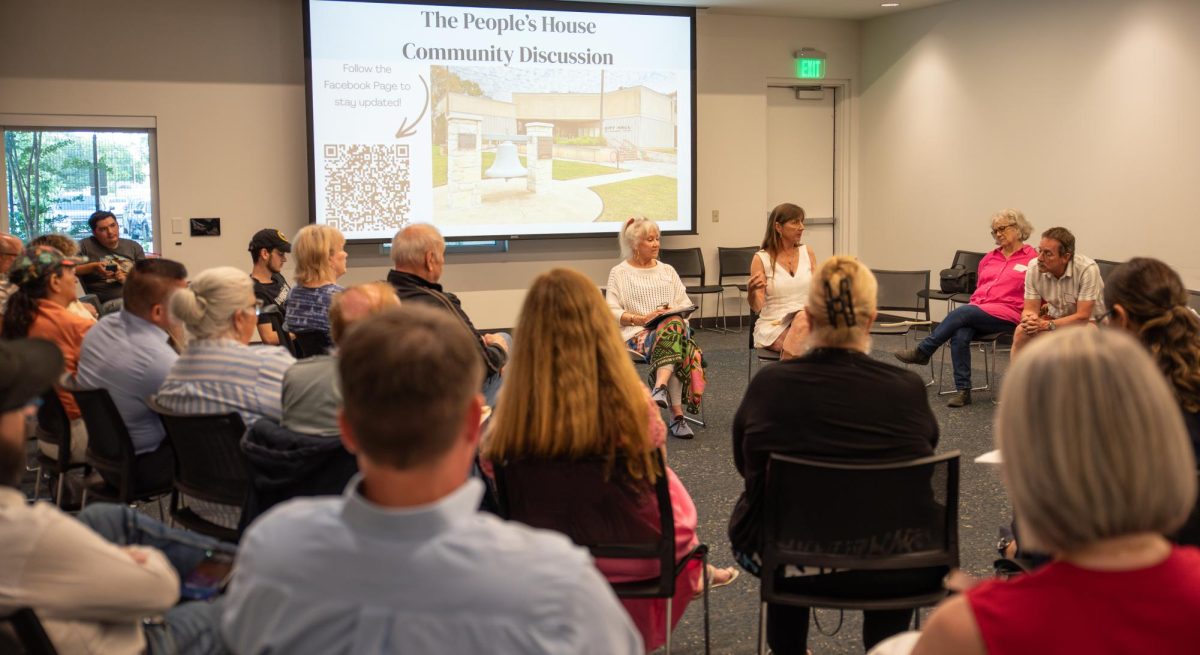
San Marcos residents gathered for a community-organized town hall discussion about the city’s proposed multimillion-dollar city hall project at the San Marcos Public Library.
Residents questioned city officials on the project’s scope and raised concerns about key details during a community discussion on the evening of June 11. Many residents, such as Lisa Prewitt, a former San Marcos City Council member and one of the community organizers of the event, said there was a perceived lack of transparency regarding the city hall project.
“We wanted some answers to some of the concerns that we had about the financing, what the potential debt could be for the city [would be],” Prewitt said. “So those were a lot of the questions that we had and didn’t feel like the venue at City Hall, where you have a three-minute citizen comment, was the place that we could actually go in … and have a two-way conversation about some of the things that we wanted to know.”
The community-led town hall came just days before the June 16 San Marcos City Council work session, where council members will receive an update on the project and consider three potential sites for the new City Hall.
Multiple city officials, including Assistant City Manager Rodney Gonzales, Economic and Local Business Development Department Director Helen Ramirez and current San Marcos Council member Lorenzo Gonzalez, attended the event to answer questions from residents and address confusion about specific details of the project.
Prewitt said much of the confusion centered on how the city would finance the proposed City Hall project, which is estimated to cost between $80 million and $100 million.
“Would there be an opportunity to scale back the project now, and do something at a lower level in case [the city gets] into financial tight spaces,” Prewitt said. “So I hope that those are the things that we hear council members ask on Tuesday.”
“We wanted some answers to some of the concerns that we had about the financing, what the potential debt could be for the city,” Prewitt said. “Could we scale down just the necessity of city hall and land that we owned [so the project] wouldn’t take any property off the tax roll.”
The project remains in the early feasibility stages and city officials will not finalize costs or funding plans until City Council selects a site and a preferred development option, though Rodney Gonzales said that council had already ruled out funding it through a property tax increase.
Rodney Gonzales said the city is considering three potential sites for a new City Hall. Two of the options are city-owned: a parcel on Hopkins Street directly north of the current City Hall and an expansion of the existing City Hall.
The third option, according to Rodney Gonzales, is located in the city’s downtown and would require the city to purchase the land located primarily at 312 E. Hopkins St. and 101 S. Edward Gary St., from Upward Communities LLC.
According to Nadine Cesak, the assistant director of communications for the city, the New City Hall Steering Committee prefers the downtown development.
The final development will depend on the sub-plan City Council chooses and could include a large parking garage, retail space, a fire station, public amenities as well as a new City Hall complex.
While the development of a new city hall has been ongoing since April 2024, officials did not consider the downtown parcel as a potential option until Upward Communities submitted a proposal for the properties in June 2025.
“So at this point, we’re at the same point we were several months ago, [before the downtown proposal] except with three options.” Lorenzo Gonzalez said. “So I think the community either doesn’t understand that or is refusing to understand that … but I think that the community will be pleasantly surprised come Wednesday morning, regardless of what the outcome is on [June 16].”
Ramirez said the current City Hall, which was constructed in 1975 when the city’s population was 18,860, no longer meets the city’s needs, leaving several city departments spread across multiple buildings instead of housed in one centralized location.
“We need 109,000 square feet [for the project], because we have many departments separated out [currently],” Ramirez said. “I’ve been there where people are going to interview for a job and they don’t know what building they’re supposed to go to for the interview … and people get confused, our community gets confused.”
Residents, such as Prewitt, asked staff whether telework or hybrid work arrangements could reduce the need for a larger City Hall.
Rodney Gonzales and other city officials present said in response that upcoming city workforce reductions would limit the municipality’s ability to offer remote work options for employees.
“[San Marcos is] a lean operating city government, we are cutting 27 positions because we want to be aligned with the coming [city budget],” Rodney Gonzales said. “What that means is where you might have had some flexibility if one person’s teleworking, then at least one person’s at the customer service desk, we’re not gonna have that flexibility because we’re operating very lean.”
Another part of the city staff’s preference for the downtown site, according to Rodney Gonzales, was the site’s potential to spur economic growth and diversification in the city’s downtown.
“We know through this city government building, that would be great retail space centers for spaces,” Rodney Gonzales said. “And a local business, whether they’re existing or someone who’s trying to think of something to do, can have access to a local space.”
Other cities, such as Austin and Pflugerville, have also used their city hall projects as vehicles to increase economic development and public access to amenities within their respective communities.
Even so, both town hall organizers and city staff agreed that community discussions, such as the library town hall, remain important as the project continues to take shape.
“It is a super exciting thing for us to build a new city hall, the people’s house,” Prewitt said. “To have everybody in the community have an opportunity to come together and have a two-way conversation about that would be great.”
Residents seeking more information about the project can visit the city’s informational page, which includes presentations, meeting materials and information about the development of the new city hall.