

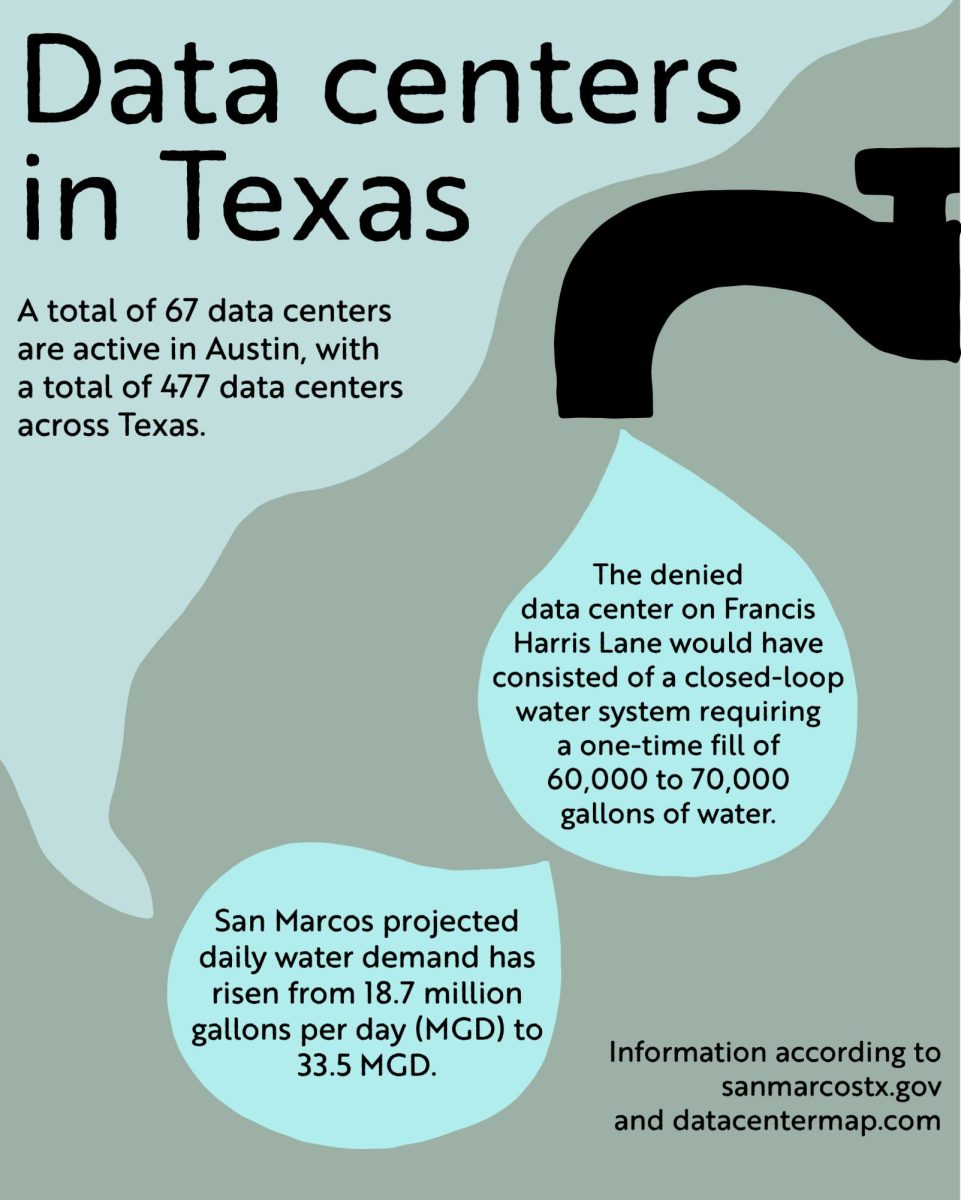
San Marcos became one of the first Texas cities to ban data centers within city limits, utilizing its home rule authority.
During its June 16 meeting, the city council updated the Land Development Code and Design Manual, effectively banning data centers while setting restrictions on this type of future development, making it not possible for a data center to be built in the city. The decision came after months of discussing the future of data centers and a denied data center proposal.
Cities with populations over 5,000 and have adopted a home rule charter, like San Marcos, have home rule authority, which gives them the right to create their own zoning codes and control development within their jurisdiction, however, their authority is not absolute with country regulations and state preemption, or higher authority.
Recently, Hays County commissioners passed a mostly symbolic resolution on June 23, to pause the development of data centers due to water scarcity.
Counties are limited by the state’s local government code and are without home rule authority, which restricts their powers to regulate development within their borders, including a lack of general zoning authority.
According to Councilmember Amanda Rodriguez, the prohibition is a change to the development code itself, with no loopholes or workarounds as well as an approval from the council for heavy industrial zoning.
“Therefore, if a developer approaches us as a city now, it doesn’t matter if they say ‘hey, I have a great project, I’m going to put it over here.’ It does not matter. It is not allowed in the city, that is an authority county do not have,” Rodriguez said.
This is the second attempt to pass an amendment to the Land Development Code and Design Manual to ban data centers. Rodriguez attempted to pass an identical amendment, but it failed 3-4 in March.
The new resolution, brought forward by Councilmember Lorenzo Gonzales, passed 4-3, with Councilmembers Joshua Paselk, Matthew Mendoza and Mayor Jane Hughson dissenting.
Hughson said during the meeting that she did not want to remove the possibility of data centers completely and was hopeful they would improve with time.
“As long as these are required to come before us, I’d like to leave the opportunity … I’m holding out hope that as time goes on, that the technology will be better, and things will shake out,” Hughson said during the meeting.
Rodriguez said there are only a few heavy industrial zoning districts left within San Marcos. Currently, the city doesn’t have any active data center proposals.
“It is not my job as a politician to force-feed a certain type of development that people just don’t want,” Rodriguez said.
As one of the first cities in Texas to pass an out-right ban on data centers, Rodriguez said she felt surreal to see her proposition go so far.
“I felt that it’s one thing for us to deny data center, but it’s another thing to sit here and figure out how can we additionally substantively address this issue of data centers, whether it be a full out ban or regulating what they would look like in the future should they come,” Rodriguez said.
Zachary Tyndall, a San Marcos citizen and member of the Data Center Action Coalition, said the complete ban was a welcome surprise from the council.
“It’s felt really good to see the changes in city council to where, you know, a year ago many of them didn’t seem very concerned about data centers and over that year through the advocacy of the community, seeing their perspective change, whether it’s a true change of heart or just bowing to the public pressure, whatever it is, it’s good to see that council is more and more responsive to these concerns from the community,” Tyndall said.
Tyndall said it is important that other cities realize that they can do a total ban on data centers, just like San Marcos.
“I think we’ve made more progress on [the fight against data centers] than I would have expected, as far as I know we’re the first city in Texas to effectively ban data centers,” Tyndall said.
A possible workaround when data centers go outside of city bounds, like the Cloudburst Data Center sitting on the edge of the city limits, Rodriguez said the centers need a lot from cities, from wastewater, electricity and general water to the point where they will turn to counties for resources.
“[Cloudburst is] wanting things from us as a city too, they’re already talking about potentially approaching us for reclaimed water,” Rodgriuez said. “So that idea that they can just exist without connecting to something it’s just not there, it’s not the reality.”
Rodriguez said while the ban may feel like a win at the moment, data centers are a persistent issue, and the fight has to be taken to the next levels of government to be taken seriously.
“This cannot be an issue that just ends with San Marcos …It is incumbent on us to take this discussion to the state and plead with the state to allow our counties to strike a balance, to have more regulatory authority and to dictate what is allowed in their counties,” Rodriguez said.
James Philips contributed to this article.