
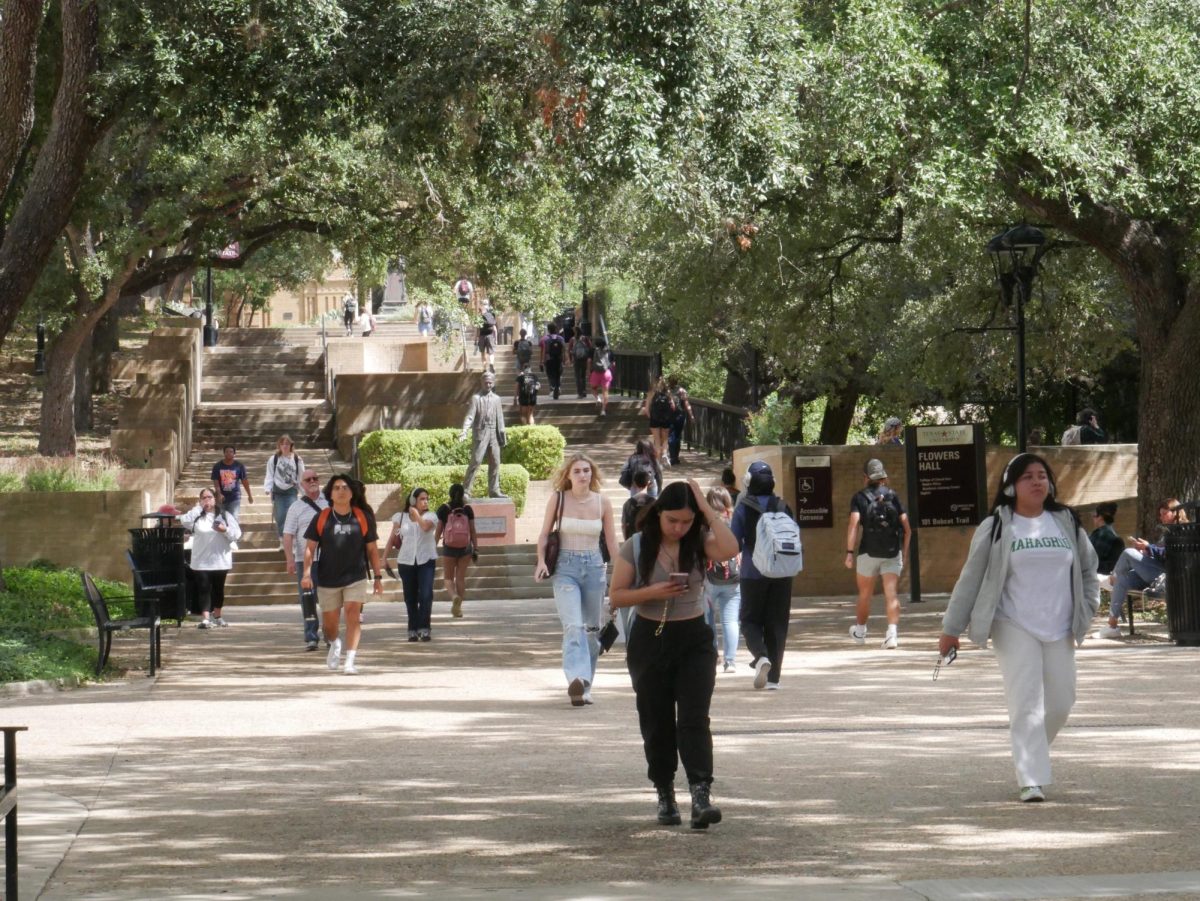
In response to allegations by the ACLU of Texas, Texas State released a statement saying it did not revoke an invitation or approval for a Black History museum visit.
In a statement released at 9 p.m. Friday, President Kelly Damphousse wrote that a staff member in the Department of Student Involvement and Engagement previously reached out to Khalid el-Hakim, Founder of the Black History 101 Mobile Museum, to seek information about being a potential exhibitor. However, Damphousse claims no contract or agreement was made.
Members of the TXST MLK and Black History Month Planning Committee decided to “highlight the rich history of Black students, faculty, staff, and alumni at TXST rather than including other options like the Mobile Museum for 2026,” according to the statement.
“Unfortunately, when Dr. el-Hakim was informed of the decision, the staff member incorrectly cited Senate Bill 17 among the reasons for the decision in the email. Dr. el-Hakim expressed his disappointment in a LinkedIn post in November, which was when I first became aware of the decision,” Damphousse wrote in his statement.
Damphousse wrote that the museum was not “canceled” or “banned” as no formal invitation was extended and no contract was initiated, and the museum was never officially added to the 2026 program.
“While it is not part of this year’s official Black History Month events, the museum may still be invited to campus by a registered student organization following our established procedures,” Damphousse wrote in his statement. “It may also be considered again for future Black History Month programming at TXST.”
This response comes after the American Civil Liberties Union (ACLU) of Texas wrote a letter to Damphousse, admonishing the university for cancelling the Black History Mobile Museum 101 event.
According to the letter, university officials invited el-Hakim in early October, but revoked the invitation two weeks later. The ACLU wrote that university officials cited Senate Bill 17, which sought to ban DEI, “the current climate of our state,” and “certain topics covered as part of the museum,” as reasons for revoking the approval.
“On October 13, 2025, a director of campus activities at Texas State University invited Dr. el-Hakim to bring the mobile museum to campus in February of 2026, for Black History Month,” the ACLU wrote in its letter. “Dr. el-Hakim accepted the invitation and spent the next two weeks coordinating details with Texas State. But on October 28, that same campus official, after consulting with ‘supervisors and the leadership team,’ cancelled the event in an email to … el-Hakim.”
Jayme Blaschke, assistant director for the Office of Media Relations at Texas State, said the notice of the cancellation to el-Hakim incorrectly stated it was due to SB 17. However, Blaschke did not contest the reasons.
“Texas State University is planning a range of events and activities to celebrate Black History Month in 2026. The planning process was a collaborative effort among various university entities to create a schedule for the San Marcos and Round Rock campuses,” Blaschke wrote in his email. “The decision not to include the Black History 101 Mobile Museum in the programming list was made at the departmental level as part of that department’s planning process.”
In its letter to Damphousse, the ACLU accused the university of viewpoint discrimination. They said the university’s decision violated the First Amendment’s protections for freedom of speech.
“Canceling this event based on viewpoint not only violates the First Amendment but also stifles free speech on campus to the detriment of Texas State’s students, faculty, staff, and visitors,” the ACLU wrote in its letter.
Editor’s note: On Dec. 22, Texas State sent a response letter to the ACLU of Texas. Read it here.