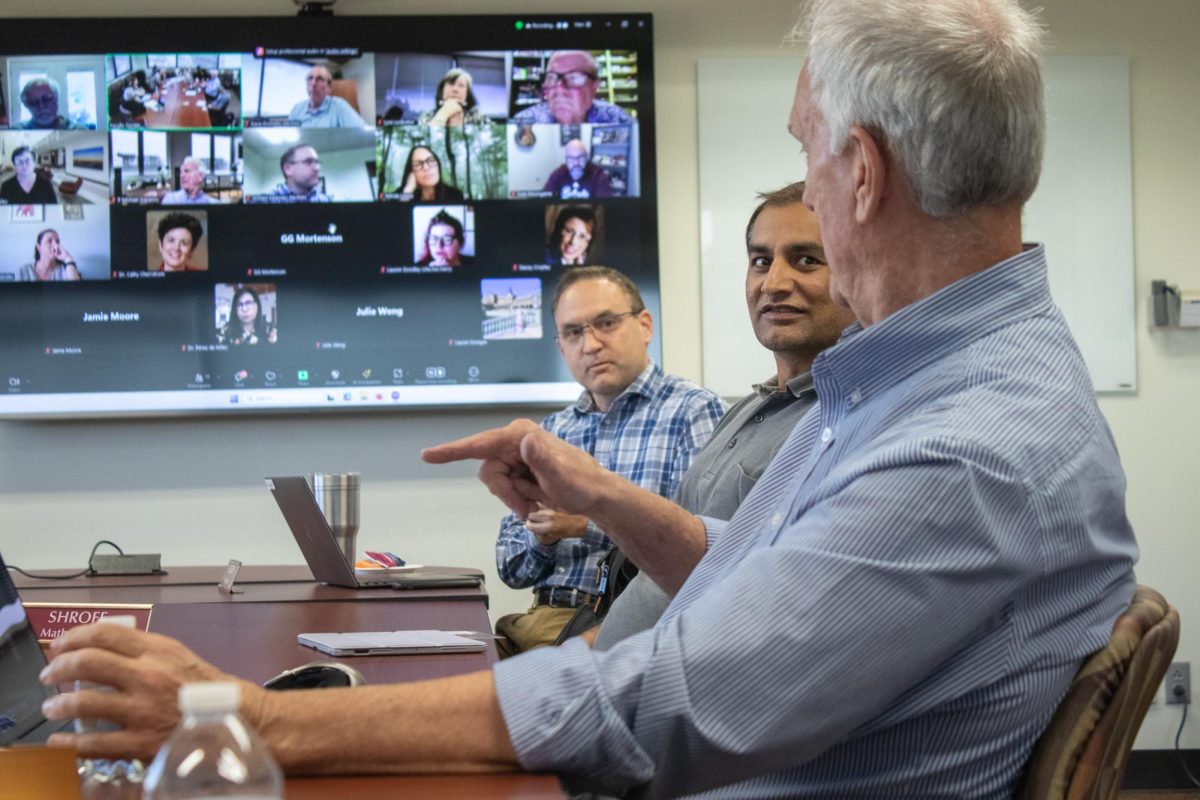


Texas State administrators confirmed that the university tracks any device connected to its wireless network at the Feb. 4 faculty senate meeting.
According to Matthew Hall, vice president for information technology, the tracking technology is part of a space management tool called Campus IQ. Hall said data from the technology is currently used to improve the wireless network access on campus.
“It’s really about wireless access planning for the IT shop, and then for [The Provost] and Eric [Algoe] to do capacity management in the buildings that are in question,” Hall said.
Hall said the technology works by tracking and mapping the number of devices connected to a wireless access point on a heatmap to show where more access points could be needed.
Members of the faculty senate expressed concern about whether the technology could be used to track individual people across campus.
Hall said it was not used that way, however he did say the university would turn over tracking information to law enforcement if it was subpoenaed or if presented with a warrant. Hall also mentioned an incident where he turned over data to the University Police Department after a carjacking in the Edward Gary Street Garage. He said Campus IQ keeps the tracking data for 180 days.
“We do track you as you sort of egress from [access point] to [access point], so we would be able to reconstruct that trail, if we had to,” Hall said. “We’re not actively [reconstructing the trail]. We don’t have an interest in that.”
Professor Noland Martin, elected senator for the College of Science and Engineering, said his department chair previously said the technology would be used to track whether faculty members were actually using their office space or not.
“It was said that they were going to use this specifically to, and two examples were given, one to see if you really need your office, or are you utilizing your office for a sufficient amount of time such that maybe you need to have a shared office, or not an office at all,” Martin said. “And the second one, if [researchers] are assigned to labs, how often are individuals going into the labs that [they’re] assigned to?”
Provost Pranesh Aswath denied that the technology is currently being used that way, saying department chairs have much better ways of tracking office usage. However, Executive Vice President Eric Algoe said he hadn’t thought of that before and was interested in the possibility of using Campus IQ to track building usage more broadly.
“As the space manager for the university, I think it’s a valid thing. It’s not a decision-making tool, but it is something that can help us ask good questions,” Algoe said. “I wouldn’t say that it won’t ever be used for that, but that I’m now thinking of it for the first time.”
Hall also suggested the technology could be used to track classroom usage.
“The whole course catalog could be linked to it, and we could tie students to it in terms of the overall patterns, and do classrooms, but it’s a massive amount of work to get to that level of understanding,” Hall said.
According to Hall, Campus IQ is still being tested at Texas State and has not been fully implemented.