

Among the sparkly skulls and yellow-orange marigolds, an abundance of paper butterflies and hummingbirds surround the ofrenda in Lampasas Hall. Each aerial animal carries the name of a departed loved one on its body, holding their spirit to visit the living and provide guidance.
Día de los Muertos, or Day of the Dead, is an annual Mexican and Latin American tradition that takes place Nov. 1-2 and commemorates the dearly departed. Friends and families celebrate by creating ofrendas, often decorated with portraits of deceased loved ones and offerings of food, flowers and candles to guide them to the living. To honor the holiday, the Honors College in Lampasas Hall prepares an ofrenda centered around a theme.
Michelle Sotolongo, Honors College advisor, said this year’s theme is centered around butterflies and hummingbirds.
“There’s a lot of symbolism attached to those two animals and images in different cultures, but when it comes to the Day of the Dead, it is part of the pre-Hispanic tradition or belief that our ancestors, our loved ones and spirits would return to visit during this season as butterflies or as hummingbirds,” Sotolongo said.
Many Indigenous groups, such as the Aztecs, believed the souls of the departed would return as hummingbirds and butterflies, creating the centuries-old link between spirituality and the monarch butterflies’ annual return. San Marcos lies within the monarch butterflies’ migration path to central Mexico. The butterflies tend to make an appearance going southbound in October and return going northbound in March.
“Since monarch butterflies are not a very common sighting during the year other than when they’re returning back, it has the belief that if we see a butterfly in another time, it’s because it’s a loved one who’s coming to visit us,” Gloria Velásquez, professor of instruction at the Department of World Languages and Literature, said.
Hummingbirds are also seen around this time, as they are present in pre-Hispanic cultures as spirits returning to visit as birds. Velásquez said hummingbirds help with the pain of loss. As someone from Mexico who identifies with an Indigenous ancestry, Velásquez said when a hummingbird approaches a person and does not move away when they speak to them, it is a loved one coming back to tell them they can let go and that they are OK. She recently encountered a hummingbird after her father died in July.
“I was there [in my office], trying to work because I was not able to concentrate, and I was thinking of the days when I was little and [my father] used to hold my hand and take us to the park, and out of nowhere, there’s a hummingbird next to my window looking in,” Velásquez said. “Was it a coincidence? Perhaps, but did it bring me a sense of peace? It did.”
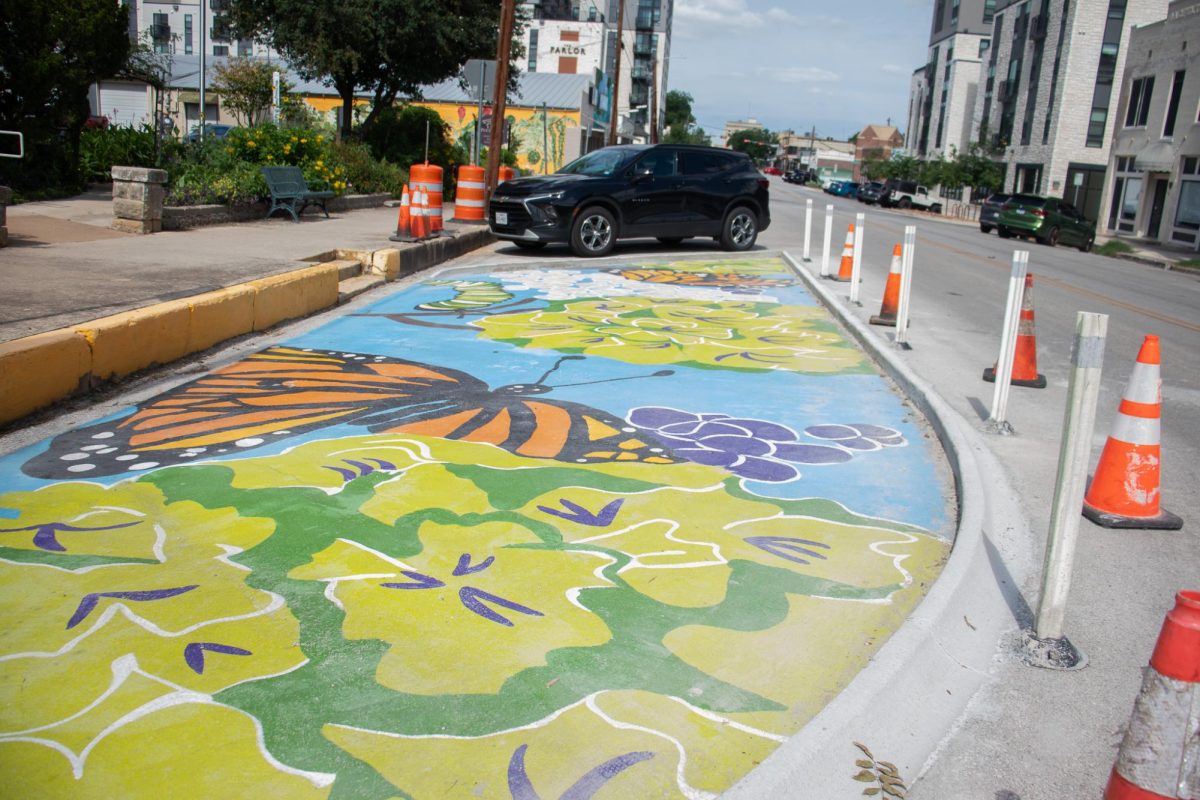
Sotolongo said the ofrenda’s theme was also inspired by being a part of the San Marcos Mural Arts Committee, which began in 2014 to bring more murals to the city. A member since 2017, she became interested in one of its upcoming projects, temporarily called the “Pollinator Wings,” which seeks to add butterfly, bee, bat, bird and beetle wings to buildings.
“We thought it was a great way to spread the word about how important pollinators are to our ecosystem,” Charlotte Wattigny, creative and marketing manager of the Convention and Visitor Bureau, said. “We were looking at how some cities have angel wings you can stand in front of and take a picture. We thought, ‘What would be cooler than having all five pollinator-type wings on different buildings?'”
Across from the ofrenda, there are QR codes nearby that lead to the monarch butterfly’s migration pattern and San Marcos’ designations. San Marcos became a Monarch Champion City last fall and a Bird City in January. Sotolongo believes it is important for people to learn about pollinators and appreciate the ecosystem people share.
“There are lots of people who are part of both [the Texas State and San Marcos] communities,” Sotolongo said. “We’re sharing these resources in this space, the land. There’s always the town-and-gown tension, the students versus the locals, but all of us here, and we’re coexisting in this time and place. And so, we should be aware of what that means and any kind of consequences or opportunities that that may present.”
Sotolongo has created new ofrenda themes since the early 2000s, and she hopes people can learn from them whenever they walk by the Honors College.
“Hopefully, [students are] learning something either culturally or about our local community and environment and feeling like they have contributed something, or maybe it’s connecting to students on another personal level, like it reminds them of home or their families,” Sotolongo said. “That’s something that everybody’s looking for: that sense of belonging and connection.”

The Honors College’s ofrenda will be up until Nov. 7 on the fourth floor of Lampasas Hall.