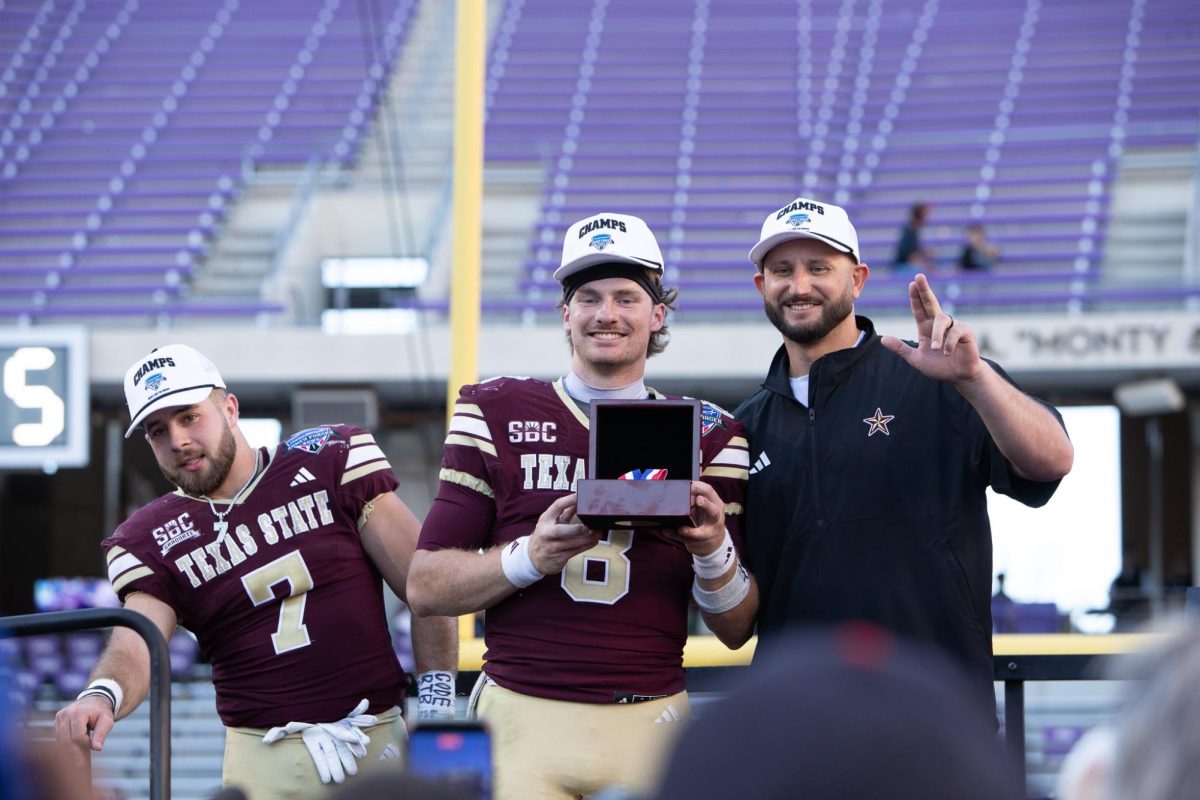
Three weeks into the 2025 football season, Texas State is sitting at 2-1 with victories over Eastern Michigan and UTSA, along with a loss to Arizona State. The Bobcats are looking to establish an identity for themselves, from a high-powered offense to a defense that still looks to be the team’s Achilles heel. Here is a breakdown of the first three weeks of Bobcat football.
Still one of the nation’s most potent offenses
According to the NCAA’s official stats website, Texas State is 38th in the country in total offense. Amassing 1,363 total yards of offense (453.3 yards per game), the Bobcats haven’t had much of a problem moving the football up and down the field.
Texas State is also tied for 45th in scoring offense, putting up an average of 36.7 points per game. At risk of stating the obvious, scoring as many points as possible is the goal on offense, but as of now, the magic number for Texas State is 35. When scoring 35 or more points, the Bobcats are 15-2 under head coach GJ Kinne. When scoring less than 35, they are 3-9.
All of this to say, if the Bobcat offense keeps putting up points at the clip they have been, it should be a successful final run in the Sun Belt.
Defense could improve
Juxtaposing the high-powered offense, the defensive unit has been lackluster thus far. Texas State ranks near the very bottom of the NCAA in total defense, giving up 429.3 yards per game, a number that lands it at 115th in the nation out of 134 teams.
It’s hard to pinpoint what exactly has been wrong with Texas State on the defensive side of the ball, but starting with fixing the rushing defense appears to be the biggest step. The Bobcats are 126th in the nation in rushing defense as they have been getting gashed for 211 yards per game.
One reason for the gaping hole in the run defense so far has been the inability to wrap up, a development that has been consistent over the first three weeks. Half of football is tackling, the other half is not getting tackled, and at this point in the season, the Bobcats can’t seem to bring their opponents to the ground.
Unless the defense adjusts quickly, it appears this will be a season full of shootouts.
Jackson, Sparks and Pare
Brad Jackson, Beau Sparks and Lincoln Pare have been the catalysts so far for Kinne and company.
Sparks leads the nation in touchdown receptions with five on the young season and is 12th in the U.S. with 307 yards. Sparks has formed an early connection with Jackson and appears to be his quarterback’s most reliable target at the moment.
Pare ranks 16th in the country with 100 yards on the ground per game. The departure of former Bobcat Ismail Mahdi to the University of Arizona opened the door for Pare to take center stage as lead back.
Pare wasted no time stepping into the shoes Mahdi left, announcing his presence to Bobcat Nation in last season’s First Responder Bowl. Pare rushed for 143 yards in last year’s bowl game and hasn’t looked back since.
Sparks and Pare have been crucial to Jackson’s early-season success. Despite his poise and calmness, Jackson is still a redshirt freshman; the importance of having two playmakers he can rely on can’t be understated. But not all credit should be given to his offensive weapons.
Jackson is 34th in the country in passing efficiency and ranks in the top 30 with six passing touchdowns and in the top 50 with a 67% completion percentage. While Jackson still has plenty of room to grow and the years ahead to do so, it’s hard to deny the promise that he shows.