

Students and faculty gathered on Thursday, April 23, at The Stallions before marching across campus to deliver a list of sanctuary demands to administrators.
Around 25 to 30 protesters marched to the J.C. Kellam Administration Building to demand the university adopt policies protecting immigrant students, expand free speech protection and increase transparency in leadership decisions, as a part of a broader push to make Texas State a sanctuary campus.
To make Texas State a sanctuary campus, the university needs to limit its cooperation with Immigration and Customs Enforcement (ICE) and to agree not to share student information with outside organizations, according to Bryce Jones, mutual aid coordinator for the Young Democratic Socialists of America (YDSA) and political science sophomore.
Jones said all of the students involved in the protest have spent two semesters building a campaign to push the university toward becoming a sanctuary campus.
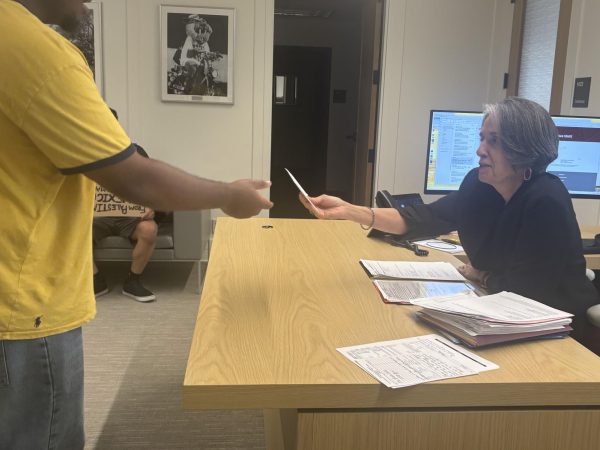
Students marched from The Stallions to the J.C. Kellam Administration Building at 12:30 p.m. to deliver their list of demands directly to university leadership.
The coalition presented a list of demands organized into five categories: free expression, faculty protections, students rights, cultural independence and transparency.
Under free expression, protesters are calling for a formal commitment to free speech principles and the adoption of the Chicago Statement, protection of controversial or “offensive” speech and the repeal of restrictive expressive activity policies. Texas State currently permits students, faculty and staff to protest between the hours of 8 a.m. to 10 p.m. in common outdoor areas like The Stallions, Bobcat Trail and the LBJ Mall. However, expressive activity is strictly prohibited during the last two weeks of every semester to avoid interfering with finals, due to Texas’ Senate Bill 2972.
The coalition’s academic freedom demands include prohibiting retaliation against faculty, reinstating former Professor Thomas Alter and Associate Philosophy Professor Idris Robinson and increasing transparency in contract renewals.
Among the list of demands, protesters called for the immediate cessation of syllabus and course audits, and an end of the threat of a forced withdrawal.
Student protestors also demand protections for cultural programming, independent student media, public budget hearings and more democratic oversight of university speech policies.
”Texas State has such a positive history of protecting free speech, but I’ve noticed it’s been hindered starting in the fall 2025,” Jones said. “I felt so alienated when the Christian Nationalists made an appearance on campus. My entire community of Black students, other minorities, women, Christians and the LGBTQ+ community felt alienated as well, and we never got an apology from the university.”
As of September 1, 2025, Texas SB 2972 removed previous expressive activity laws and allowed Texas State to restrict outdoor common area protests to students, faculty and staff. Non-university individuals are now prohibited from spontaneous, unapproved protests on campus and must seek university sponsorship or formal approval.
Jones said the pattern of incidents includes putting Associate Philosophy Professor Idris Robinson on leave, the firing of former Associate History Professor Thomas Alter, the forced withdrawal of student Devion Canty Jr., and the rescinding of Dr. El-Hakim’s Black History 101 Mobile Museum invitation to campus.
“The current trajectory of Texas State University is one of managed silence, not academic excellence,” the written list of demands read. “We do not just demand the reinstatement of fired faculty or the end of coercive student discipline; we demand a fundamental shift in how this university views its duty to the public.”
The walkout was organized by a coalition of student and community groups, including the YDSA, Socialist Horizon San Marcos, Bobcat Pride, MOVE Texas, Transcend TXST, Texas State Employees Union, Palestine Solidarity and the Democratic Socialists of America.
Livy Rocha, a geography senior, said she attended the protest to advocate for immigrant protections on campus, including banning ICE presence and sharing immigration student information.
“I hope people understand the severity of the current situation Texas State is in. A lot of people don’t realize that even if you are a documented citizen, you can still be affected,” Rocha said.
Rocha said that she has seen professors censoring themselves during lectures out of fear of administrative retaliation tied to course audits.
”I feel like I’m getting restricted on what I can and can’t learn here, and that is definitely not what students pay for,” Rocha said.
Allan Hsiao, a political science sophomore, who recently transferred from a community college, said he was surprised by what he sees as limited transparency between students and university leadership.
Hsiao said he has spent countless hours researching Texas Senate Bill 37, which expands authority for university administrators and regents over curriculum, hiring and faculty governance.
The shift in authority reduced faculty influence on academic decisions and increased the potential for political influence in higher education, according to Hsiao.
”It is absolutely absurd and borderline hilarious that the university has limited when and where students can protest,” Hsiao said. “Some people think we should be grateful that we still get to gather at the Stallions, but the bar is in hell.”
As the protest concluded outside of JCK, Jones said the coalition plans to continue protesting and organizing until May 1.