
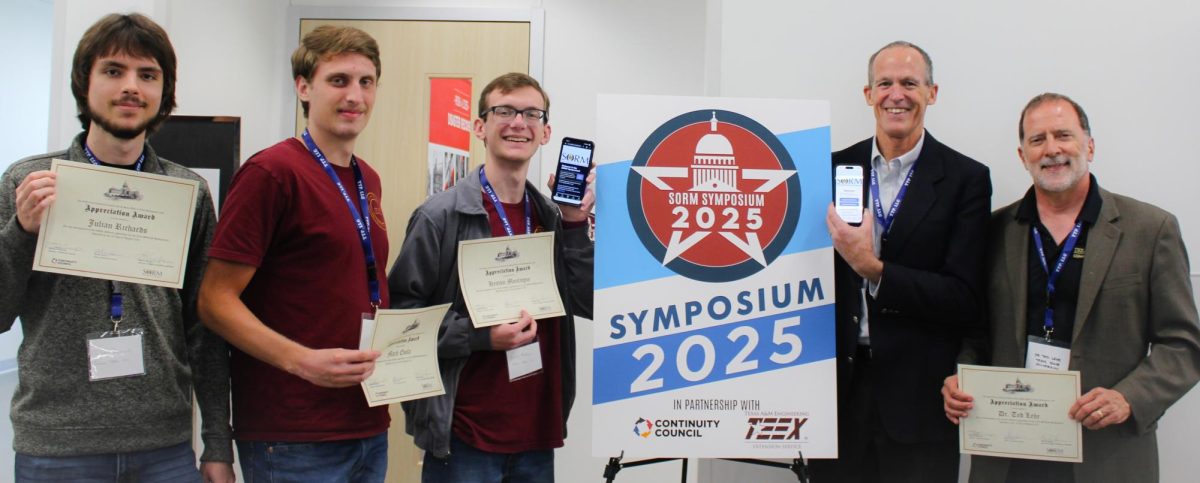
Applause echoed through the Texas A&M Les W. Bunte Jr. conference hall as a team of Texas State students took the stage to receive recognition for a new web and mobile app designed for The State Office of Risk Management’s (SORM) annual symposium.
Created in a few months, the app includes features such as interactive schedules, speaker abstracts, attendee contact tools and real-time notifications. These tools made operations more efficient and enhanced the overall experience for the symposium on August 13–15 in College Station.
Ted Lehr, associate professor of computer science and faculty sponsor for the project, said the opportunity for these students arose when SORM contacts offered the project to Texas State students. Lehr reached out to his students and a few Texas State coding clubs with the opportunity, which four students accepted. He said the project offered a challenge beyond what many students had previously encountered and praised the team’s adaptability and resourcefulness.
“I’m delighted with how well they’ve worked together and the product they’re producing,” Lehr said. “There’s something very nice, from a teacher’s perspective, that these students are doing something better than I think they could, because they’re using the tools that are available to them wisely.”
The team consisted of computer science juniors Heston Montagne and Mark Evola, computer information systems senior Julian Richards and computer science alumnus James Cowley. Montagne said they were able to create the app because of the dedication of every member. He believed each person brought a sense of ownership and pride that elevated the final product beyond expectations.
“Everyone on the team was super strong, and we were able to play into everyone’s strengths, and even when someone was struggling… we were always able to reach out to each other,” Montagne said.
The development process came with its share of challenges. Through daily meetings with SORM and the Continuity Council, a collection of public sector professionals that worked with SORM to develop strategies and host the annual symposium, the student team navigated the most intense phases with resilience and collaboration.
Robert Turner, executive sponsor for the project, said the team prioritized building a “minimum viable product,” or a bare-bones version of the app, that included only the essential features needed for it to function effectively within the tight timeline. Once that foundation was solid, the team could expand the app’s capabilities, adding features that weren’t part of the original plan.
Turner said one of his favorite additions, color-coded events by category, was a feature that started almost by accident during development. Its unexpected success became a testament to the team’s adaptability and creative problem-solving.
“[The feature] came up during one of our nightly meetings… the team did a little investigation and said, ‘Oh, yeah, we can make that happen.’ So, we put a little demo together and realized this is something we can do,” Turner said.
SORM oversees risk assessment and continuity planning for state agencies, ensuring essential operations continue during emergencies. The symposium began three years ago with the Continuity Council, which brought agencies together to share innovations and best practices for emergency preparedness. Since then, the symposium turned into a larger exchange of knowledge with many experts in the risk management field.
During the symposium, the app streamlined and transformed the flow of speaker information and contacts between people at the touch of a button.
As the symposium drew to a close, the recognition of the student developers by Turner and SORM served as a celebration of their technical achievement and a testament to the growing role of student-led innovation in public service. With possible plans for future versions, the app’s debut marks a promising shift toward user-centered tools in government operations.
Stephen Vollbrecht, former state risk manager for Texas, reflected on the collaboration, noting that working with younger minds and people dedicated to continued learning leads to unexpected innovation.
“Within institutions, in universities and students in particular, that’s where you really get to see creativity and drive shine,” Vollbrecht said. “You’re always questioning and doing things new because nobody’s told you that you can’t yet.”