
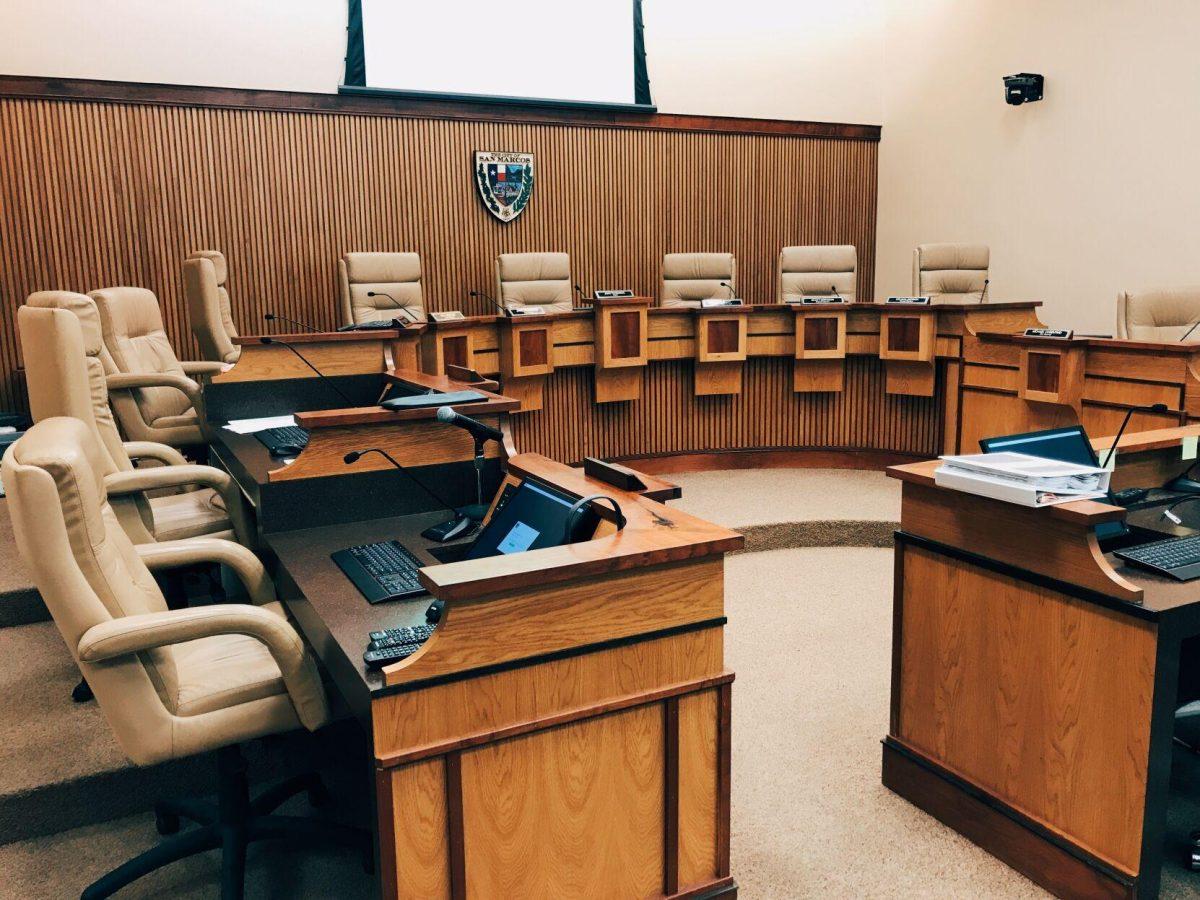
Star file photo of San Marcos City Council Chamber.
At its Aug. 19 meeting, the San Marcos City Council annexed 64 acres and denied the Preferred Scenario Amendment (PSA) for a proposed data center.
The data center proposed was by Armbrust & Brown, PLLC, on behalf of Highlander SM One, LLC, with John Mayberry representing them.
The data center had three major requests for the City Council: annex their 64 acres of land into the city limits, change their PSA from housing to commercial/employment low, and change zoning to light industrial.
The PSA was tied with the zoning amendment for the data center; one could not pass without the other. Both needed a super majority vote, at least six yes votes, to pass.
The PSA was denied two votes for no by council members Amanda Rodriguez and Saul Gonzales.
“I try to be a sensible policymaker despite what people may think,” Rodriguez said. “For the last couple of months, I have driven to the land that was talked about, to see the stars that was mentioned, and see all the work the city staff has put into it, and I can’t [stand behind it].”
During the presentation, it was stated that Cyrus One, a company interested in building a data center, is pausing its involvement with the zoning amendment, not the project.
The proposed data center would be at 904 Francis Harris Lane, adjacent to the Hays Energy Power Plant. Currently, the 64 acres of land are approved for over 470 single-family homes.
“Why would you put families near a powerplant, let alone somewhere it has been claimed it rains and it floods,” council member Matthew Mendoza said. “I would much rather see a business flood out than a family who can barely afford the home.”
There were over two hours of citizen comments, both for and against the data centers.
The presentation claims that the proposed land is not located within the 100-year floodplain or near any of the Edwards Aquifer’s recharge, contribution, or transition.
“When I got here five years ago, I became obsessed with the river. In the five years that I’ve seen [the river] change, it’s like seeing a friend on a deathbed,” San Marcos resident, Lisa Fields said. “We should be doing everything we can to conserve water. I think the message is clear from the community members that [AI data centers] will never be welcome here…If you can’t hear us when we are crying for your support, I don’t think you will ever hear us.”
During the presentation, the data center stated that they would be using a closed water system, so once the system is filled and set up, it will continue to use the same water.
The presentation said that if the city council selected the data center, the water already assigned to single-family homes would be reduced by 55% to 70%.
“If I want 470 homes as a neighbor versus a data center, that should say something.” Hays County resident Abigail Lindsey said.
The proposed data center would have been up to five separate data center buildings, that was estimated to have a total water usage of 20,000 to 35,000 gallons per day.
Mayberry compared that the daily use of the data center would be similar to that of an office building; however, in the first few days of setting up the closed loop, it would be similar to an apartment complex.
According to Mayberry, each data center building would use about 75 megawatts.
“[Comparing 75 megawatts to homes] on a typical day in San Marcos in October would be about 54,000 homes [for one building],” San Marcos Director of Utilities Tyler Hjorth said.
Hjorth stated that two of the five data center buildings consume two and a half times more power than the entire city of San Marcos’ all-time peak power. However, the data centers would not compete with any of San Marcos residents’ power.
“Megawatts is an instantaneous snapshot engineering units. If you went and measured [the data center] right now, 75 megawatts is what it would show,” Hjorth said. “But if you took a 75 megawatt building and ran it an entire month, it’s 75 times 24 hours a day time however many days in the month, and that is what shows up on the bill.”
According to the presentation, restrictions will be imposed on the data center if it is built; water usage cannot exceed 75,000 gallons per day, noise levels must be limited to 75 decibels throughout the day, should remove at least 80% of total suspended solids from the water before it is discharged and drainage facilities need to be designed and built to reduce runoff by 10%.
Mayberry also agreed to make all restrictions for the lifetime of the data center if it is to be built
Since the PSA was denied by the City Council, there is a one-year waiting period to introduce a plan similar to the PSA.
The San Marcos City Council meets at 6 p.m. every first and third Tuesday of each month. For more information, visit its website.