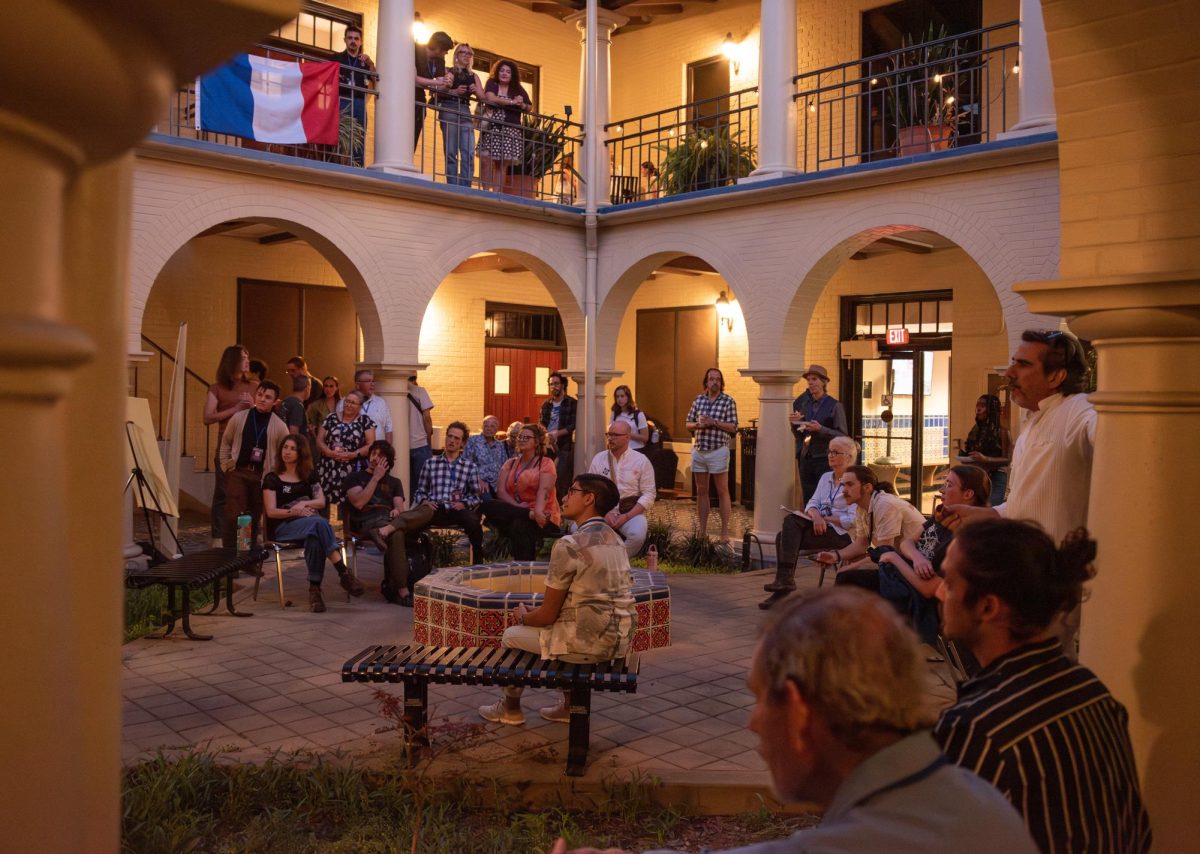


Musicians, educators and music judges filled the Gonzales Convention Center for the Chronos Saxophone Quartet’s performance at one of the biggest state-wide music conventions. As whispers in the audience faded away, the members of Chronos raised their saxophones to their lips.
Chronos is a group of four Texas State students who Todd Oxford, professor at the School of Music, wrote in an email to The Star that they have gained recognition for their elegant music making and high-level performances. It performed at an event hosted by the Texas Music Educators Association (TMEA), an organization that ensures music education in Texas, on Feb. 12.
TMEA gathered the top bands, orchestral groups and ensembles in Texas to showcase their talents.
Chronos formed at Texas State two years ago. It consists of Elijah Breda, saxophone performance junior and soprano saxophone player, Austin Parente, music education junior and alto saxophone player, Conner Zatopek, sound recording technology sophomore and tenor saxophone player and Jose Velez, music education sophomore and baritone saxophone player.
Hailing from different backgrounds, the four didn’t know they were assigned to the same quartet. Being part of an ensemble is required for most music majors, regardless of instrument, and the assignment is random.
“We were all put together … not by choice, but now these guys are like my brothers,” Parente said.
Being mostly student-led, Chronos gets free rein over its creative process. The members take advantage of that freedom as much as they can, often mixing pieces from different eras and genres into the same performance. Each member has an equal voice in the group, and they have a high amount of respect for one another.
“I think that the chemistry nails down the style with our pieces, and it allows us to be more expressive with each other,” Zatopek said.
However, Chronos didn’t just stumble into its success. The members balanced long hours of classes and studying, extracurriculars and social lives. This is combined with regularly finding time to practice alone and with three other people.
“It’s a big challenge [to find time to practice],” Velez said. “We take a lot of classes and have a lot to do, so just finding an extra space, a two-hour practice session, is very hard to do. We usually do it very late at night because we have a lot of classes during the day.”
When the members caught wind of an upcoming performance that would be their biggest stage yet, they knew what they had to do.
Chronos spent hours preparing its audition for the TMEA Music Convention, which culminated in a 20-minute-long recording sent to judges to determine if they would be selected.
The members rejoiced when TMEA selected them, but along with the joy came a new challenge. Since an audience of over 200 people was the largest Chronos had performed for, the pressure was on for the quartet.
“It’s a big deal,” Parente said. “Our professor said we had to lock in and really get our music prepared. It’s a convention where around 40,000 people go.”
The program the group chose featured songs from different genres. There were influences from the Middle East, the modern-day metal scene, jazz, Italian and Irish-inspired cuts. Chronos took the audience on a journey around the globe, and by synthesizing each different song into the same performance, showed off their technical ability.
While the performance was not judged officially, numerous judges from other competitions, music professors and performers were in attendance.
The audience diligently watched Chronos perform. Up-and-coming musicians, high-schoolers and college students who all looked up to them eagerly spoke with the members afterward.
“So many famous people, so many big performers go there … doing it with this group and seeing so many people, it felt like I [had made it],” Velez said. “That was my pinnacle moment of the quartet.”
The Chronos Saxophone Quartet’s last performance of the school year was on Feb. 28 at the Texas State University Performing Arts Center, but it aims to continue performing in fall 2026.