
Content warning: this story contains discussion of suicide.
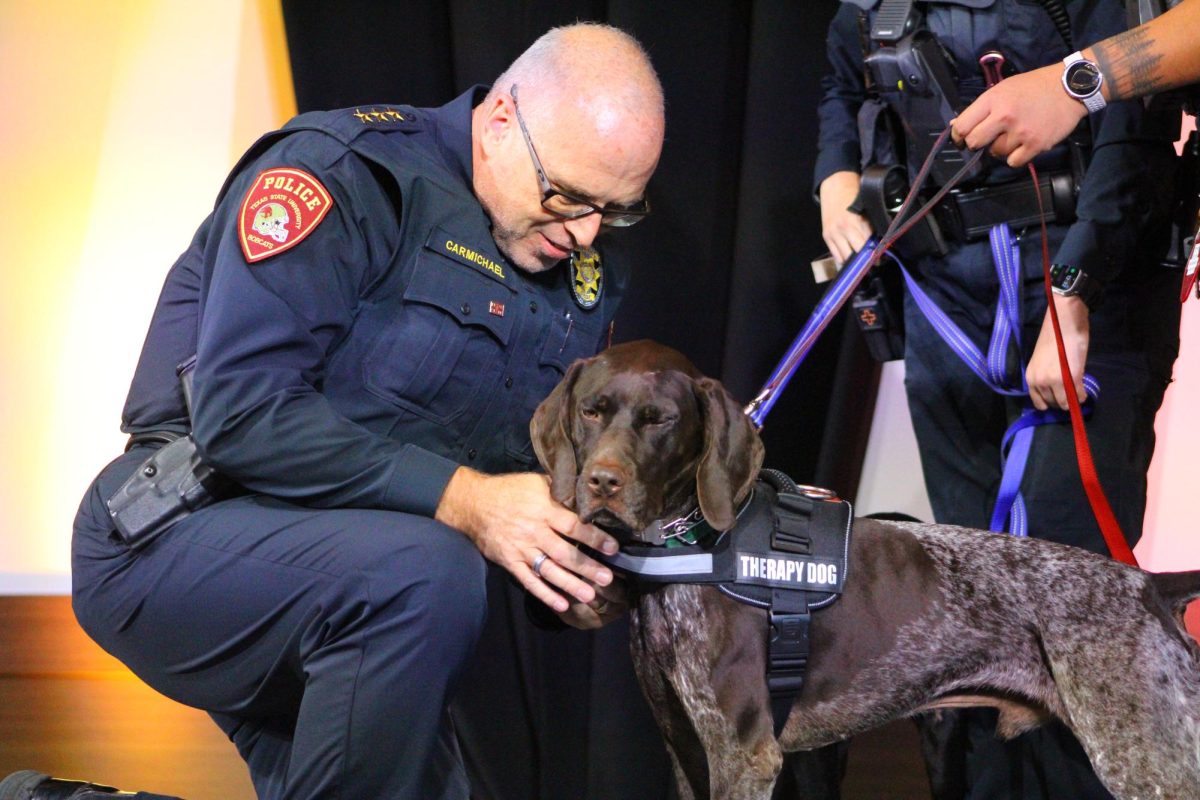
Between the applause and wagging tails, Mando and Baloo could hardly contain their excitement as they prepared to be sworn in as Texas State’s newest “pawfficers.”
This ceremony marks not only a commitment to uphold the law but also a major milestone in an officer’s career, where they make the formal transition from recruit to officer. On Jan. 28, the University Police Department (UPD) welcomed two new therapy dog officers: Mando and Baloo.
Mando is a two-to-three-year-old German Shorthaired Pointer, while Baloo is a year-old black lab mix. However, their ages and breeds are uncertain because both are from a shelter in Florida.
Eric Algoe, executive vice president for operations and chief financial officer, said it’s easy to get lost behind the cuteness factor of the therapy dogs, but they are helpful in many aspects of student health.
“They’ve only been here with us now for just a very short period of time, and we had a terrible incident since they arrived: A student committed suicide off campus,” Algoe said. “The therapy dogs were able to be deployed at the scene and to help with the people there, to help with that situation, to help diffuse things.”
Police officer Kendra Marsteller and Pawfficer Brady moved to Del Valle ISD in July 2025, due to the officer’s well-being and health, allowing Mando and Baloo to become the two new therapy K-9 units.
Algoe said therapy dogs, like Mando and Baloo, are tools to help law enforcement make connections with students in need and break down barriers within the situation.
Pawfficers Mando and Baloo received training from Paws & Stripes College at the Brevard County Sheriff’s Office in Florida to learn obedience training by selected and trained jail inmates.
UPD corporals David Velasco-Martinez and Monique Grijalva trained with Mando and Baloo in Florida for about a week to bond with the dogs and to maintain their partner’s future training.
Dean of Students Valerie Holmes said there are increasing rates of mental health issues among students who attend college.
“The reality is that our students at Texas State University actually show a higher rate [than the national average] of having anxiety and mental distress,” Holmes said. “… We only have so much clinical capacity at the institution and any institution. So, having therapy dogs are a very strategic, purposeful, high-impact way for us to address the needs of our students.”
Velasco-Martinez and Grijalva are mental health officers who are trained in providing informed and empathetic support to students in need.

Grijalva, who is paired with Baloo, said their relationship has grown stronger since their Florida training.
“As he grows, I want to try and teach him pressure therapy to help ground students who are going through a crisis, who may be worried about finals, things like that, and kind of just need a dog to relax them,” Grijalva said.
Grijalva said she has wanted to be a part of the K-9 unit for a while because she knows “the power a dog brings.”
“I’ve always had my own dogs, and they’ve been around through my tough times as a police officer,” Grijalva said. “So, it’s kind of surreal to me that I get to be a part of this program and to bring [Baloo] to this program as well.”
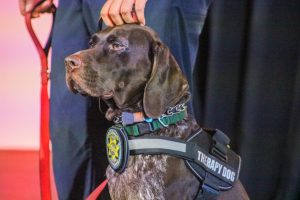
Velasco-Martinez, who is paired up with Mando, said a challenging part as an officer is knowing when to take Mando on a call or not.
“… I don’t want to come up to a room with somebody and speak about [a] theft and then they’d be allergic to dogs, so I got to make sure that not only is he safe, but the person that I’m talking to is safe as well,” Velasco-Martinez said.
Velasco-Martinez said Mando has a trick he learned on his own: if students get to eye level with Mando, he will give a hug and sometimes kisses. Velasco-Martinez often has to warn people before they go to pet Mando.
Velasco-Martinez and Grijalva will work 12-hour shifts walking around campus, responding to calls and encouraging students to stop and say hello to Mando and Baloo.
“I’m so proud of [Mando] already, just from today, [seeing] some of [the] actions he’s had with people, it makes me so happy to see that,” Velasco-Martinez said. “Having him with an actual like little badge here on his chest, it’s gonna be beautiful.”
For students who are experiencing mental health illnesses, the National Suicide Prevention Lifeline can be reached at 1-800-273-8255.