

Amphibians around the world are dying at an alarming rate due to a fast-spreading fungal disease that silently attacks their most vital organ: their skin.
At Texas State, researchers are working to understand the deadly chytrid fungus. Several endangered amphibians like the San Marcos salamander, Texas blind salamander and Houston toad are vulnerable to chytrid, creating an even bigger threat.
Royce Voss-Heflin, a biology graduate student, joined David Rodriguez, a Texas State alumnus and a mycology, genetics and bioinformatics professor, in his lab after developing an interest in mycology, which is the study of mushrooms, and said that Rodriguez Lab was the first in Texas to isolate and grow the fungus to study.
Voss-Heflin said during a chytrid demonstration in one of Rodriguez’s classes, a student mentioned seeing frogs dying on their back in her pond, a common indicator of chytrid infection. Rodriguez’s team investigated, collected samples and successfully grew the fungus in his lab.
“But chytrid isn’t just in that one pond or river,” Voss-Heflin said. “Where there are amphibians, there is also chytrid.”
Rodriguez said chytrid fungus is often referred to as the “amphibian killing fungus,” and is unlike common fungi.
“A lot of people think of fungus as mushrooms that don’t move,” Rodriguez said. “But chytrid has a flagellum, a tail-like structure, that allows it to swim through water.”
Frogs and salamanders rely on their permeable skin to breathe and absorb water, making them vulnerable to diseases, according to Rodriguez. Chytrid spores penetrate the animals skin and grow inside their bodies. Rodriguez said all amphibians can carry chytrid, though its fatality rate is still getting studied.
Rodriguez believes the global spread of chytrid fungus is driven by human activity, specifically the movement of plants, soil and the international bullfrog trade. The bullfrog trade involves the farming and transport of bullfrogs for food, pets and research. Rodriguez said bullfrogs are strangely resistant to the disease, which allows them to carry large amounts of the fungus without dying.
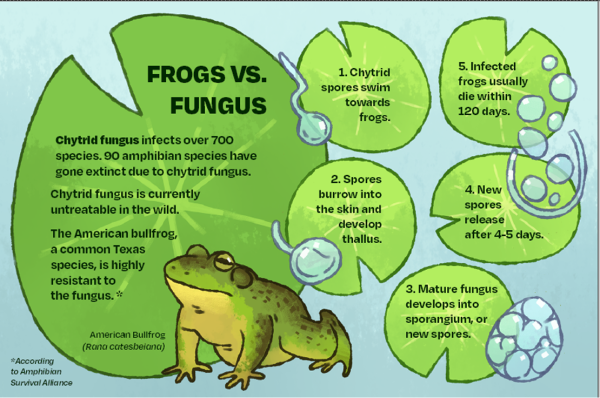
Rodriguez Lab has identified the cricket frog, native to San Marcos, to also be resistant to chytrid. Much like the bullfrog, the cricket frog is able to carry high amounts of the pathogen on its skin without dying, and transports the fungus everywhere the frog goes. However, even though the cricket frog is resistant to the disease it is not immune, according to Rodriguez.
Rodriguez said other factors like drought, predation and the recent emergence of chytrid make it difficult to provide clear statistics and contain the disease.
”Chytrid causes frogs to lose the ability to regulate ions, which causes heart attacks,” Rodriguez said. “The disease also makes them lose control of their muscles, making them easy targets for predators.”
The disease hits tropical regions the hardest, where the majority of amphibian declines and extinctions have occurred. While Texas is not seeing any amphibian extinctions caused specifically by the fungus, Rodriguez said chytrid is still present in the state and largely understudied.
“There are very few people studying Texan amphibians and chytrid. There’s a lot more work to be done to see if our native species are actually affected,” Rodriguez said.
Voss-Heflin said one of the more puzzling discoveries, and a major breakthrough in his research, is a hybrid strain of the fungus, which suggests genetic mating despite chytrid reproducing asexually. This is just one of the many questions scientists like Heflin and Rodriguez are trying to solve through research.
According to Voss-Heflin, conservation is the primary motivation behind the research of amphibian diseases.
”Amphibians play a huge role in controlling insect populations, more than most people think about. If you hate mosquitoes, you love frogs,” Voss-Heflin said.
Globally, organizations like the Amphibian and Reptile Conservancy (ARC) are working to protect vulnerable species by preserving habitats, funding research and spreading awareness about emerging threats like chytrid fungus.
“We don’t pay attention to our ecosystem until it’s too late and [the amphibians] are lost forever. We not only lose an incredibly fascinating group of animals, we lose the glue that holds healthy ecosystems together,” the ARC stated on its website.
The ARC also emphasized the need for stronger monitoring and biosecurity measures to limit the spread of wildlife diseases. Still, local conservation efforts in Texas remain limited.
Rodriguez said prevention is one of the most effective tools available to the public.
“Simple things like rinsing off your shoes and using a disinfectant spray after hiking can also prevent spreading the fungus between ecosystems,” Rodriguez said. “The best thing you can do is leave animals where you find them, and don’t dump plants or animals into the environment.”