
Farmers across Central Texas are struggling with an ongoing drought, forcing increased operating costs and difficult decisions about how to sustain business.
While dry spells are not uncommon in Central Texas, severe and persistent drought conditions began to take hold in early 2022. Data from the National Oceanic and Atmospheric Administration (NOAA) shows that San Marcos typically receives between 30 and 35 inches of precipitation annually, but it only recorded 24.7 inches in 2025.
Local growers and farmers argue that broader environmental and development trends are contributing to the drought’s long-term impact.
Carey Jones owns a small farm in San Marcos called Tickle Root and focuses on growing native Texas plants while educating the public about its environmental benefits. He said urban development and current landscaping techniques are major contributors to the ongoing drought across Central Texas.
“Construction companies don’t use Texas native [plants], they use Bermuda grass,” Jones said. “Bermuda grass has very shallow roots that don’t penetrate the soil to retain water.”
Jones said Bermuda grass is widely used in landscaping because it’s cheap and fast-growing, and its use in urban development compounds the drought problem.
“We can solve our drought burdens by planting more wildflowers and native grasses,” Jones said.
Native grasses and wildflowers develop deeper root systems, which help absorb and retain water to improve soil structure and reduce runoff, according to Jones. Without deeper roots, rainwater is more likely to flow over hardened soil surfaces and into drainage systems, rather than replenish the ecosystem.
Jones said he works hard to keep his plants affordable and continues to advocate for increased use of native species in public and private landscaping projects.
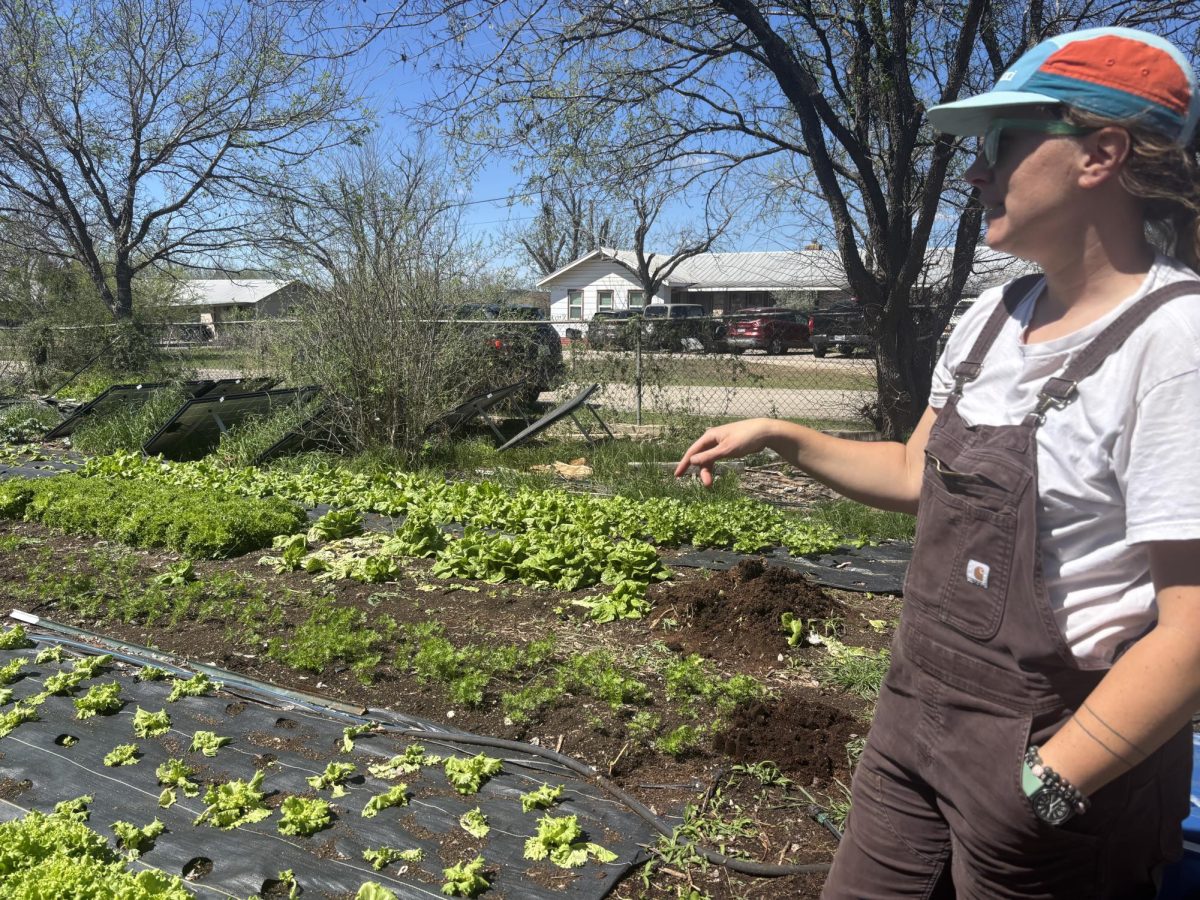
At Shook Farm in New Braunfels, owner Sarah Shook said the drought reshapes every aspect of her operation. The farm specializes in microgreens, which are young plants harvested days after sprouting instead of waiting months for the vegetable to fully develop. Shook Farm also produces a wide variety of other vegetables and has been in operation since 2021, the same year Shook began noticing abnormally dry conditions.
Shook said rising utility bills are one of her biggest concerns, as overhead watering requires more water usage than other irrigation methods. However, Shook said overhead watering is the most secure way to care for her crops, but the drought has made basic tasks more difficult.
”When I plant new crops from seed, they struggle to sprout and establish roots because the soil is so dry,” Shook said.
To conserve resources, Shook previously relied on drip irrigation, a method to deliver water directly to plant roots while minimizing waste, using a long tube to slowly drip water into the soil. According to Shook, the soil conditions have worsened, making drip irrigation ineffective.
Shook said she decided not to pass those expenses to her customers. Instead, she is branching out to local restaurants and selling produce on a larger scale to alleviate the financial stress.
According to the Texas Farm Bureau, the cost of seeds has increased 18% as of 2025 due to drought conditions limiting production, and rising fuel prices driving up the price for distribution.
”I’m feeding my friends and my community, people that I see working every day,” Shook said. “I don’t want to raise the price on them.”
Growers are not the only farmers impacted by the drought. Ranchers like Bill Bryan, owner of Bryan’s Healthy Harvest in Seguin, are taking different approaches to care for livestock.
Bryan said his farm operates on two separate pastures, one for cows and the other for chickens and sheep. He said that even with the land being irrigated, the extreme drought conditions make it difficult to maintain healthy growth.
To keep his livestock fed, the pasture also relies on two electric water pumps, which adds $100 to Bryan’s monthly utility bills. During the winter, when grass growth is even slower, Bryan had to purchase hay to feed his animals.
“The sheep go through two bales of hay daily, and those are running about $13,” Bryan said. “It doesn’t seem like much at first, but it adds up to about $800 for an entire month; it’s a lot.”
Bryan said he has had no choice but to raise prices to keep the business viable. Even with extra water pumps, the farm is operating at full capacity and cannot support additional livestock at this time.
Bryan’s Healthy Harvest uses regenerative soil practices, a technique designed to improve soil health and water retention through natural grazing and fertilization from livestock, but it takes time to produce results.
As drought conditions persist, farmers say their ability to adapt will depend not just on rainfall, but also on community support and long-term changes in how land and water are managed.
“If we want to be drought resistant, we have to plant like it and use [Texas] native plants,” Jones said. “It starts with our community making those choices.”