
Content warning: The following report contains descriptions of sexual violence, assault and abuse.
With holidays like Valentine’s Day around the corner, The National Domestic Violence Hotline reports an increase in domestic and dating violence cases due to heightened expectations, financial pressure, and alcohol consumption.
At least one in three Texans will experience domestic violence in their lifetime, according to a study by The Family Place.
Chaston Porter, an anthropology freshman, said he previously experienced dating violence but was unaware of Texas State’s support services.
“Never be afraid because the longer you wait, the worse it’s going to get,” Porter said. “So just seek out help when you can and try to find someone to confide in.”
Under the Jeanne Clery Disclosure of Campus Security Policy and Campus Crime Statistics Act, known as the Clery Act, colleges and universities that receive federal funding are required to report campus crime statistics and define the categories used in their reporting.
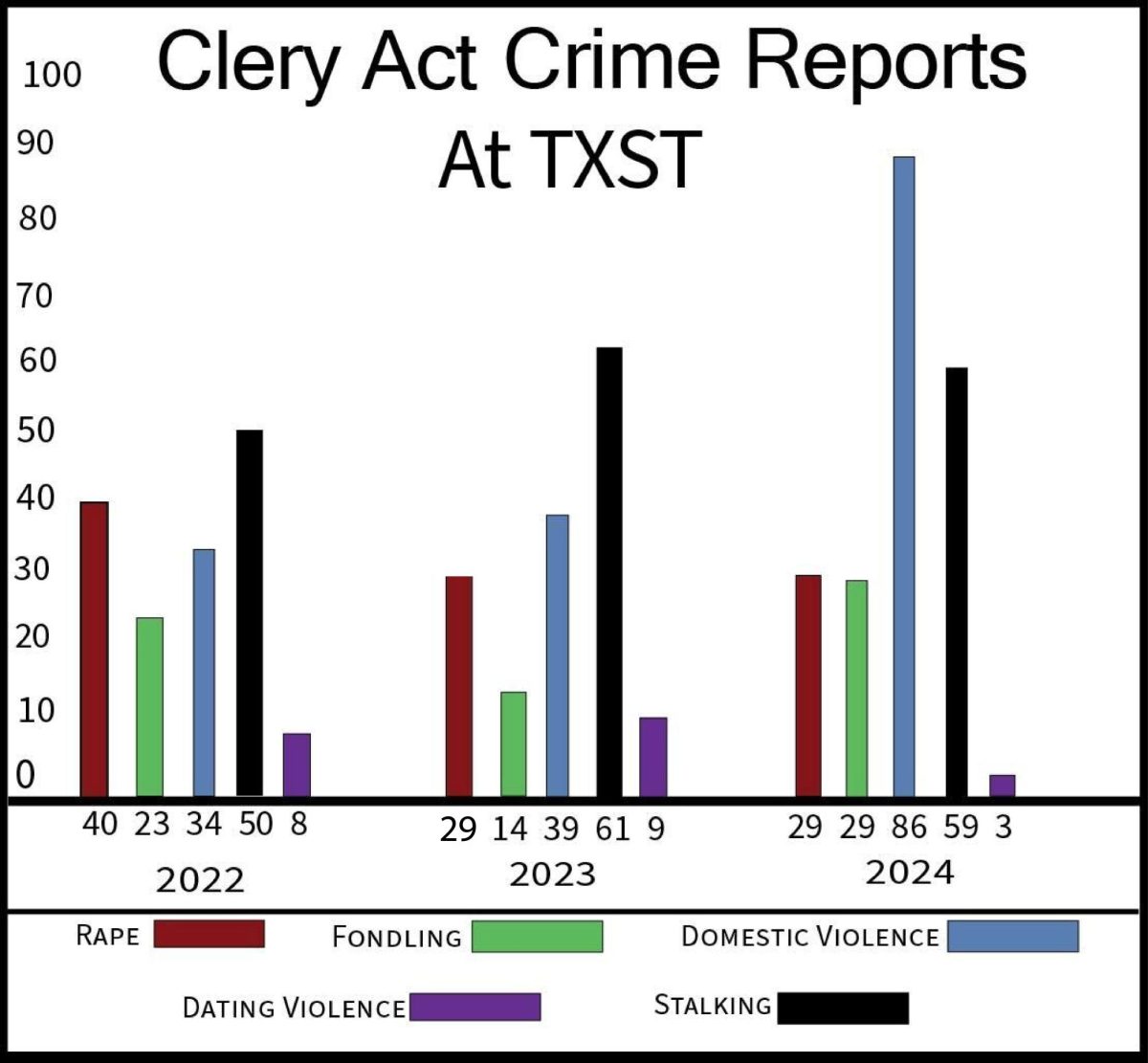
Texas State University’s Clery data from the past three years shows shifting patterns in reported incidents of rape, domestic violence, dating violence, fondling and stalking, illustrating the scope of interpersonal violence on campus.
According to Clery data from Texas State’s San Marcos campus, in 2024 there were 86 reported domestic violence cases, with 77 occurring in residential facilities and one happening off-campus. In 2023, there was a total of 39 cases of domestic violence.
The Texas Family Code includes dating violence in its definition of domestic violence. Roommates are a protected class in the code and are included in domestic violence statistics. Twenty-three of the reports of domestic violence in 2024 were between roommates, and 25 of them were intimidation/threats of violence, according to the Texas State Clery data.
According to the Clery Act, domestic violence is defined as a felony or misdemeanor crime of violence committed by a current or former spouse or intimate partner, a person with whom the victim shares a child, a cohabitating partner or any individual protected under the domestic or family violence laws of the jurisdiction in which the crime of violence occurred. Dating violence is defined as violence committed by a person who is or has been in a romantic or intimate social relationship with the victim.
Marisa Montelongo, Students Against Violence (SAV) peer education supervisor and health promotion specialist, said the organization’s outreach helps create a space for students to learn about dating violence, recognize warning signs and connect with support resources.
“We get a lot of people that we present to that are really appreciative that we’re here as an educational space and that we provide a space for people to be able to talk about this topic and their experiences,” Montelongo said.
Danielle Arciniega, a mass communication senior, said she experienced emotional abuse in a previous relationship and struggled to leave.
“I just had a hard time leaving because of apologies,” Arciniega said. “I’d go back, and nothing changed, but I was just used to having him around.”
To raise awareness ahead of Valentine’s Day, SAV partnered with the Hays-Caldwell Women’s Center to host a #WhyIStayed tabling event on Tuesday, Feb. 4, at the LBJ Student Center to provide students with information about support services available both on and off campus. The event invited students to anonymously share personal experiences, which is now shown in the LBJSC Hub to promote awareness and understanding.
The #WhyIStayed movement is a social media campaign and advocacy movement started in 2014 by author and domestic violence survivor Beverly Gooden. The hashtag was created as a response to a Baltimore Ravens running back Ray Rice’s domestic violence scandal, where the public blamed his fiancée for staying with him after being assaulted. Survivors used the hashtag to promote understanding of fear, financial dependence and emotional manipulation inside relationships and gave survivors a platform to share their stories.
Arciniega said she now believes healthy relationships are based on trust and communication instead of control.
February is also recognized as Dating Violence Awareness Month to raise awareness and encourage people experiencing abuse to seek help.
University officials encourage students experiencing domestic or dating violence to seek help through campus resources or the National Domestic Violence Hotline at 800-799-7233, which offers confidential support 24 hours a day.