
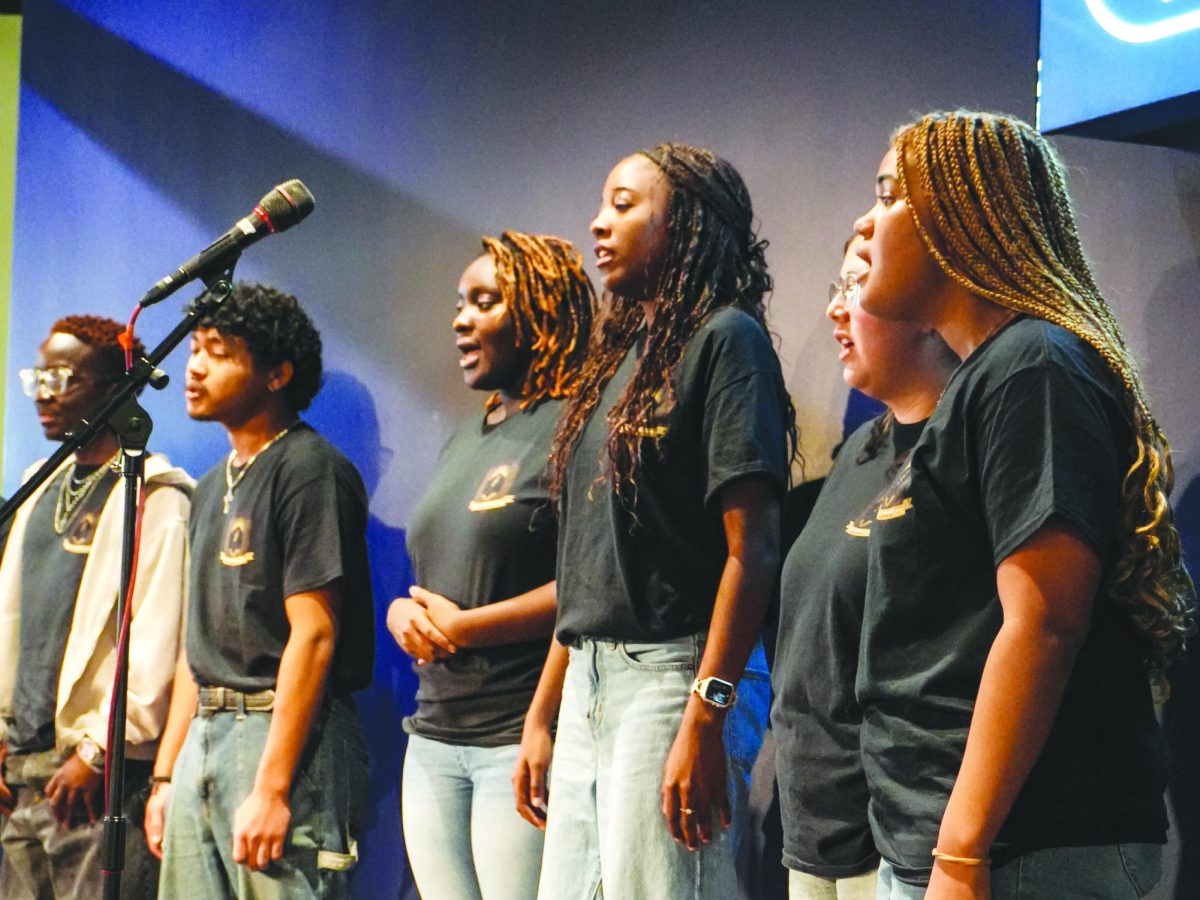
The lights at George’s in the LBJ Student Center were dim, casting a warm glow over the intimate crowd that gathered for “A Century of Creativity: Black Voices and Vision.
Organized by Student Involvement, the Black History Month event brought students together on Feb. 3 to celebrate Black creativity through food, music and spoken word. Before performances began, guests were served a buffet that reflected Black culinary traditions, including jerk chicken, cornbread, deviled eggs, rice, gumbo and banana pudding. Organizers handed out Black History Month pins and stickers at the front of the room as students filtered in and settled into their seats.
In an email sent to students ahead of the event, the Division of Student Success noted that this year marks “100 years since the first national observance of Black History Month,” framing the celebration as part of a broader campus effort to honor Black history and culture.
The night opened with a performance by the Gospel Expression Association, a student choir invited by Student Involvement. AJ Saafi, music education senior and president of the Gospel Expression Association, said the group was eager to participate upon receiving the invitation.
“Student Involvement reached out to us and wanted us to represent Black culture for Black History Month,” Saafi said. “We wanted to be here for the culture and to share gospel music with everyone.”
The group performed “Emmanuel” by Norman Hutchins, drawing applause and nods from the audience. Later in the night, the choir returned to perform “Lift Every Voice and Sing,” which it referred to as the Black national anthem.
Alexandria Ellison, vocal performance senior and the choir’s social media chair, said the song choices were intentional.
“The first song really speaks to the Black church experience,” Ellison said. “And with ‘Lift Every Voice and Sing,’ it’s important that we keep singing it and passing it down just like our ancestors did.”
Following the choir’s opening performance, Janelle Lott took the stage. Lott, English senior and the event’s spoken word poet, performed an original poem titled “To Evolve or Repeat,” which explored themes of identity, generational cycles and self-definition.
Lott said the poem was inspired by Jason Reynolds’ novel “Long Way Down” and her own experiences as a biracial Black and Mexican woman. Lott also said this was one of the first times she had publicly performed her poetry, and she wanted to push past her comfort zone.
“I kept asking myself, ‘Do I want to evolve or repeat the cycle?’” Lott said. “’Do I want to keep doing what’s expected, or do I want to build something of my own?’ … This felt like the right space to say that.”
For Lott, performing during Black History Month carried personal significance.
“Black History Month shouldn’t just be a month,” Lott said. “It’s about acknowledging Black people, Black culture and all the beauty that comes with it and honoring what came before you so you can build what comes next.”
Throughout the night, the stage remained open to Black students who wanted to share their voices. Performances ranged from live music to poetry centered on Black identity, history and self-expression. Each performance was met with loud applause and affirmations from the audience.
Jordan Patton, accounting junior, was one of the students who spontaneously signed up to perform an original poem titled “I GIVE THANKS.” He said he had never performed a poem publicly before. His poem reflected on gratitude for Black History and the generations who made it possible for him to pursue his goals.
“I’ve always written poetry, but it was just a matter of getting up there and doing it,” Patton said. “College feels like the easiest time to take that risk.”
Patton said Black History Month is especially meaningful to him after growing up in predominantly white spaces.
“Sometimes you feel like you’re not as important in certain spaces,” Patton said. “So, being here, around people who understand that experience, really matters.”
Deshon Fields, film junior, also performed a poem titled “Still, We Rise in Every Shade,” which challenged the idea of limiting Black history to a single month.
“Black people have been doing great things all year round,” Fields said. “This event gives us space to show where things really came from the music, the food, the culture.”
For attendees, the event served as a celebration and a place of comfort. Nina Simone, health administration freshman, said she came to support artists who were brave enough to share their work.
“This feels like a space of community,” Simone said. “Everyone here seems comfortable being themselves.”
Through music, poetry and food, “A Century of Creativity: Black Voices and Vision” transformed George’s into a space of reflection, celebration and community.
For Patton, the experience was about more than performance: it was about remembrance.
“So many people fought for me to be able to do this, especially in this space,” Patton said. “I’m thankful to them.”