
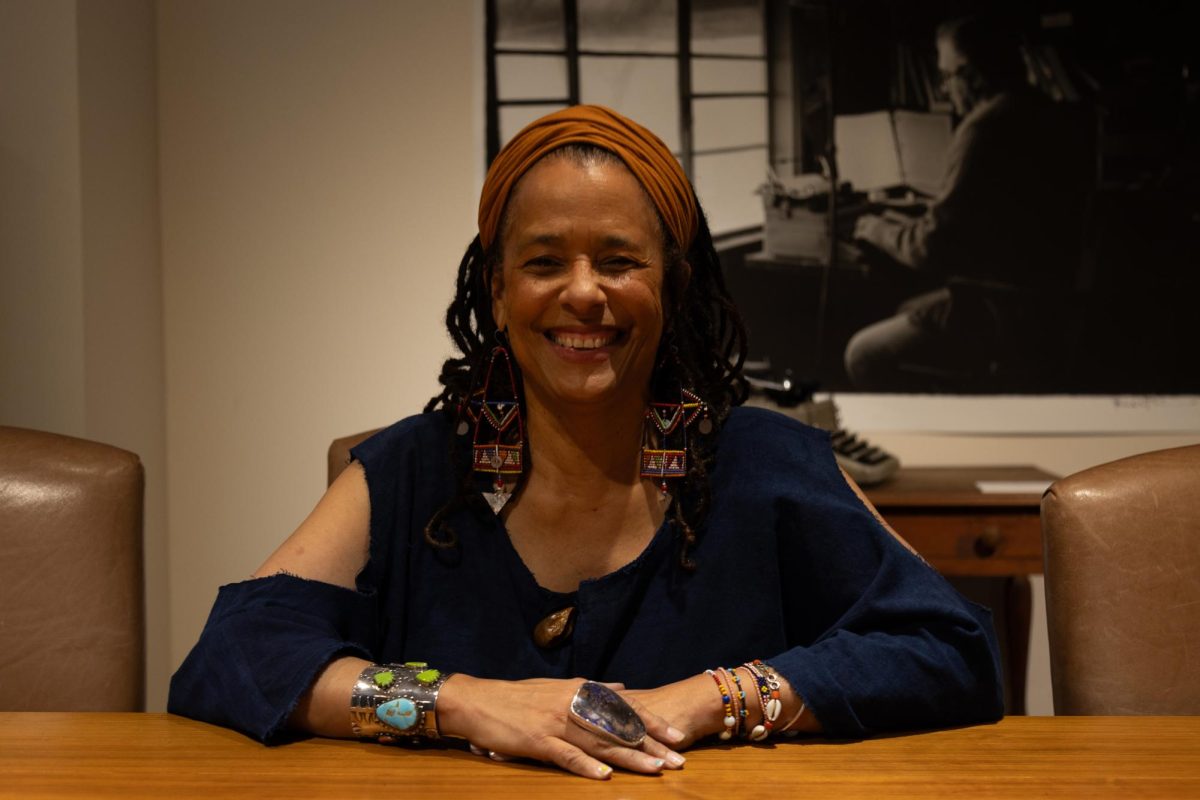
Students and professors filled the Wittliff Collections as scholar and storyteller Carolyn Finney brought lively discussions about how memory, “place” and identity intertwine.
Finney, a renowned cultural geographer and author of the 2014 book “Black Faces, White Spaces: Reimagining the Relationship of African Americans to the Great Outdoors,” spoke on March 25 about how race affects people’s access to and relationships with green spaces. She said history is often biased and is not always as distant as people may think.
Finney never intended to become a geographer. Instead, she wanted to understand people from different places. She said she always thought about “place” in terms of the people who lived there, but never “place” as geography.
“I realized I was spending a lot of time thinking about ‘place,’” Finney said. “As much as I was thinking about people and what we do and how we do it within ‘place,’ I just never knew it was a thing you could study.”
Texas State’s Department of English invited Finney as the final speaker this semester for the Therese Kayser Lindsey Literary Series, where various authors delivered free public readings of their work. The series highlighted authors who worked in both academic and creative writing. Organizers believed Finney’s conservation work would be of great value to Texas State students, especially considering the San Marcos River runs through campus.
Shannon Shaw, associate professor of instruction in the English department, helped coordinate Finney’s book talk at the Wittliff. She said Finney’s work has a special impact on the Texas State community because of the university’s connection to the river, the number of conservationists who graduate from Texas State and those who take advantage of the Meadows Center.
“I think that having a speaker who understands the cultural significance of green spaces is going to be helpful to our Texas State students in understanding the history of conservation and having access to green spaces,” Shaw said. “I mean, we’re really lucky to have that here on campus and to have the research.”
Finney said her main goal before her speech was to meet students where they were and to hold discussions based on what they needed to hear, rather than just talk about herself and her book. During her book talk, students asked questions about how she keeps herself safe while traveling, how she is learning to forgive individuals for systemic issues and several other topics.
Briaysia Goodspeed, digital media innovation freshman, said she was particularly touched by Finney’s response to her question about safety while traveling. She said hearing that Finney could backpack by herself gave her the confidence to reach her travel goals.
“I liked her talking about going different places, traveling as a Black woman, because it’s something that I want to do as well, and I know that I’m kind of intimidated to go a lot of places because of their views on Black people,” Goodspeed said.
Finney based her book talk on the idea that people are in the middle of history and their reactions in the present time shape their future.
“It’s always so interesting to me that we’re always looking to the future because the future never arrives,” Finney said. “I’m interested in how we are right now in the present and in particular how we are understanding and looking at history, because we’re doing an excellent job, in my humble opinion.”
To view “Black Faces, White Spaces: Reimagining the Relationship of African Americans to the Great Outdoors,” visit Perlego at https://www.everand.com/book/322772523/Black-Faces-White-Spaces-Reimagining-the-Relationship-of-African-Americans-to-the-Great-Outdoors?