
Over 40 frames decorate the entrance to the third floor of Alkek Library, each one showcasing photos, articles and memorabilia highlighting several decades of Black history at Texas State.
“63 Years of TXST Black History” is a collaborative exhibit with Student Involvement & Engagement and the Special Collections & Archives department to display the growth of the Black community and culture at Texas State. It also celebrates 63 years since the integration of Black students to then Southwest Texas State College.
Deion Robbins, former coordinator for student organization development and administration, started planning the exhibit last November. He said his vision was to create an event he had not seen during his time working at the university.
“Typically, when we host event-to-campus activities, most of them are super large-scale and active events, and for Black History Month, I wanted to do something more passive that had an educational purpose and a meaning to it,” Robbins said.
Robbins discussed the idea with a planning committee composed of students, faculty and staff to clarify ideas. Brandon Vannatta, coordinator for campus programming, was part of the committee. He said he liked the idea of having a meaningful month-long exhibit that focused on the Black history of Texas State.
“When [Robbins] brought that idea to us, it was a perfect encapsulation of something that students can just come and enjoy on their free time, as well as get to the point of the hundred years [since Black History Month’s origins] and all the Texas State history together,” Vannatta said.
The committee focused on what they could find that related to students and faculty who went to the university. This required contacting The Wittliff for Elvin Holt’s, the first Black tenured English professor, theater and literature pieces. They also contacted Special Collections & Archives for old yearbooks to look for the first of different feats and for Black students who made an impact.
While searching the archives, Vannatta said it was interesting learning how quickly Black students made a name for themselves, as most Black fraternities and sororities were present on campus by the late 1970s. Robbins said he enjoyed flipping through the yearbooks and viewing the journey from the 1960s to the current day.
“It was nice to see how far the Black culture and Black community have come at Texas State University, and just in general, the campus climate as a whole, seeing Texas State then versus what it is now,” Robbins said. “It was very enlightening. I learned a lot going through all those yearbooks and archives about the university that I didn’t know.”
Robbins and Vannatta searched for students who were the first of their kind and those who had accomplishments after their time at Texas State. Vannatta said it was important to show current students that what they are doing now is important and can reflect on their future success in life.
“It’s very important to show both [those who made a name for themselves while at Texas State and after], because I think a lot of students either focus on one or the other, so we really wanted to show that you can do a lot while you’re at college, but also you can do a lot after, and they both hold the same amount of weight, because it all just depends on what makes you proud in the end,” Vannatta said.
The committee wanted to focus on Black student involvement by including Black Greek life and student organizations.
Kendall Wyatt, chapter president of the Alpha Kappa Alpha sorority, said she visited the exhibit multiple times. She said she appreciated how close-knit the Black population was at Texas State, especially in the Greek world, and learned new information due to the exhibit’s existence.
“I really did see something about Greek life [that stuck out to me], and obviously, as a member of a Greek organization here on campus, I felt it very admirational just to see my organization back in the day and see the moments they were able to have here together,” Wyatt said.
Based on the feedback, Robbins said he believes future heritage months or cultural celebrations could run this type of event.
“I have a feeling that this is something that we probably will keep, moving forward, and I have a feeling it may trickle its way down into our other cultural celebrations, like Women’s History Month [and] Hispanic Heritage Month, and since we are a Hispanic-serving Institution, that may play into it as well,” Robbins said.
-
A frame display a photo of an Ensemble Theatre production sits in a glass case, Monday, Feb. 23, 2026, on the third floor of Alkek Library.

-
An edited copy of “The Night of Baker’s End” script by playwright Ted Shine sits in a glass case, Monday, Feb. 23, 2026, on the third floor of Alkek Library.

-
Frames displaying photos of Marcellus Alexander and Shirley Harris sit in a glass case, Monday, Feb. 23, 2026, on the third floor of Alkek Library.

-
Frame displaying a photo of director Thomas Carter and a design representing Texas State’s first Black-focused Homecoming celebration sit in a glass case, Monday, Feb. 23, 2026, on the third floor of Alkek Library.

-
Frames displaying photos of Marcellus Alexander and Corey Benbow sits next to a name plaque of Texas State’s student body presidents from 2015-2024 in a glass case, Monday, Feb. 23, 2026, on the third floor of Alkek Library.

-
Frames displaying photos of Elvin Holt and Freedom Hall sit in a glass case, Monday, Feb. 23, 2026, on the third floor of Alkek Library.

-
Frames displaying photos of Earl Moseley and Carrington Tatum sit in a glass case, Monday, Feb. 23, 2026, on the third floor of Alkek Library.

-
Frames display information about Drew Fucci, Charles Austin and Johnny Brown, Monday, Feb. 23, 2026, on the third floor of Alkek Library. Fucci and Austin were known as the first Bobcats to win NCAA national championships, while Brown was the university’s first Black student athlete.

-
Frames display information about the Xi Delta Chapter of Omega Psi Phi and Alpha Phi Alpha Fraternity, Monday, Feb. 23, 2026, on the third floor of Alkek Library. The organizations were Texas State’s first Black fraternity chapter and black Greek-lettered organization.

-
Frames display information about the Ebony’s Platers performance of “A Raisin in the Sun,” Monday, Feb. 23, 2026, on the third floor of Alkek Library.

-
Frames display information about Delta Sigma Theta, Monday, Feb. 23, 2026, on the third floor of Alkek Library. The organization was Texas State’s first Black sorority chapter.

-
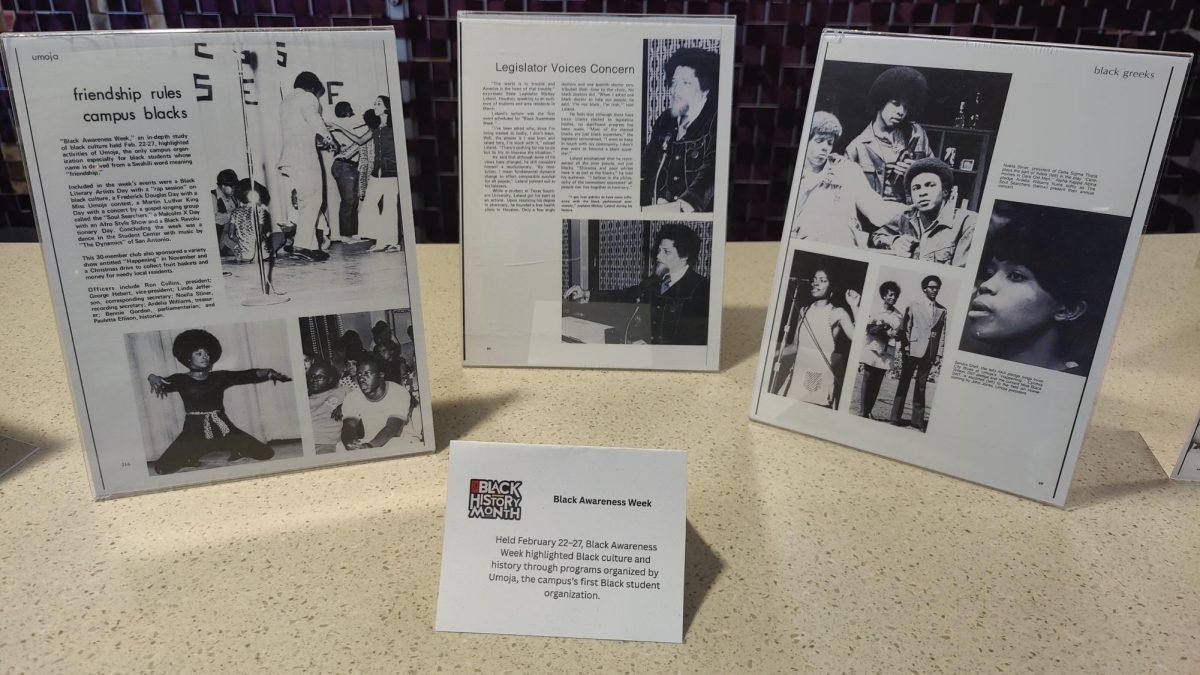
Frames display information about “Black Awareness Week,” which highlighted activities led by Umoja, and the club’s other events, Monday, Feb. 23, 2026, on the third floor of Alkek Library. Umoja, meaning “unity” in Swahili, was the first campus organization for Black students.

-
Frames display information about the Prairie View A&M students’ visit to then-called Southwest Texas University, Monday, Feb. 23, 2026, on the third floor of Alkek Library. The visit was part of an exchange program between the two colleges to study each others’ curriculum and customs.

-
Frames displaying a photo of the Freedom Five” stands next to a video of a minute-long poem, Monday, Feb. 23, 2026, on the third floor of Alkek Library. The poem, narrated by associate dean of Student Success and Curriculum Laurie Fluker, is about what it takes to make a difference.

-
Frames display information about Southwest Texas’ Black History Month celebration and about demonstrators following Martin Luther King Jr.’s death, Monday, Feb. 23, 2026, on the third floor of Alkek Library.

-
Frames display information about the club Umoja, Monday, Feb. 23, 2026, on the third floor of Alkek Library.


The “63 Years of TXST Black History” exhibit will run until Feb. 28 on the third floor of Alkek Library