
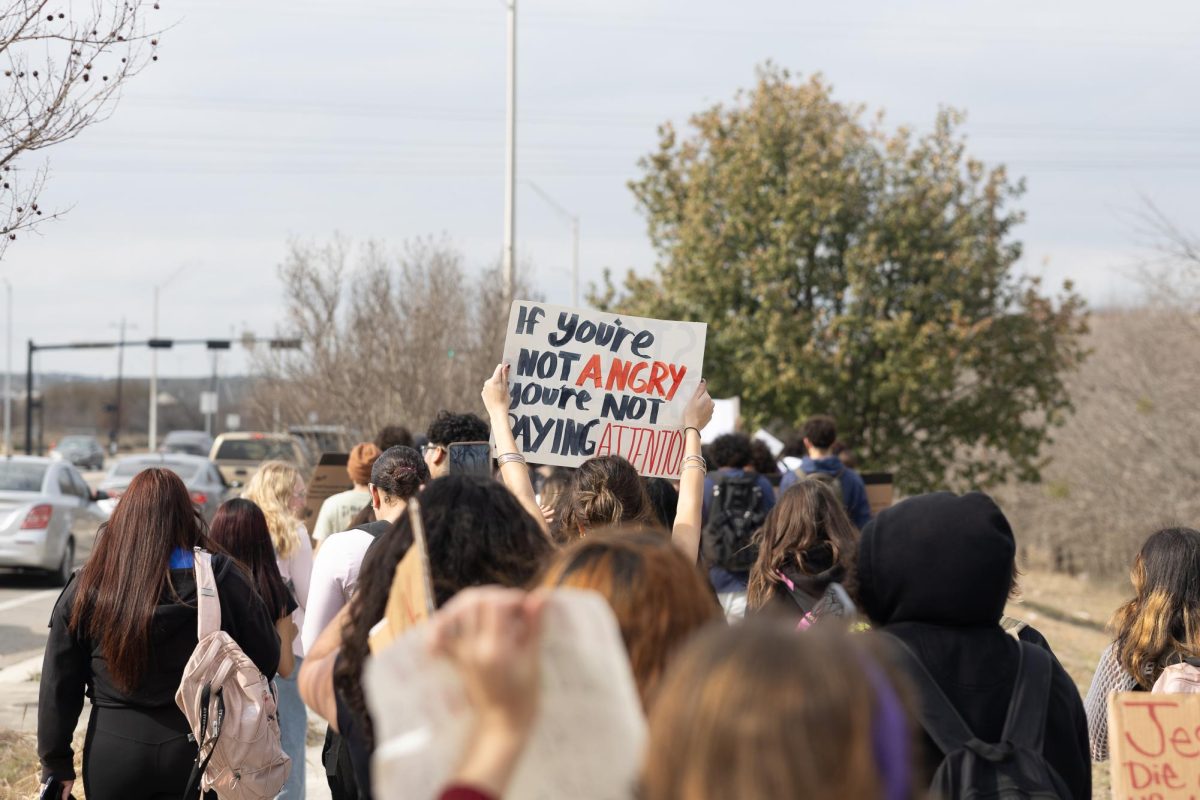
Texas State education students could face uncertainty in clinical placements after Gov. Greg Abbott threatened funding cuts to districts that allowed student walkout protests.
Texas State’s Educator Preparation Program partners with multiple districts to place student teachers in paid residencies and clinical teaching assignments. The program requires students to be on their assigned campuses and advises against holding outside employment due to the time commitment.
According to Texas State’s Office of Educator Preparation website, resident teachers are paid by their respective school districts. San Marcos CISD pilot residencies offer $20,000 during the year-long placement, and Traditional Pathway candidates are eligible for paid teaching positions ranging from $2,000 to $10,000 per semester. The program maintains paid partnerships with Austin ISD, Hutto ISD, Ki Charter Academy, Lockhart ISD, Manor ISD, Prairie Lea ISD and San Marcos CISD, all of which had students participate in anti-ICE walkouts.
“Schools and staff who allow this behavior should be treated as co-conspirators … We are also looking into stripping the funding of schools that abandon their duty to teach our kids the curriculum required by law,” Abbott wrote on X on Feb. 3.
Shortly after Abbott’s post, the Texas Education Agency (TEA) issued a warning to school districts, stating that encouraging or allowing walkouts during instructional hours could lead to severe penalties, including teacher investigations, loss of federal funding and potential state takeover of districts. The agency said districts could face consequences under Texas Election Code Section 255.003, which prohibits the use of public resources for political advocacy. Because the state calculates funding based on Average Daily Attendance, students marked absent during walkouts could lower district funding, placing financial pressure on districts partnered with Texas State.
Aimed at districts that allowed students to participate in anti-ICE walkouts on Feb. 3, the warnings carry consequences that could extend beyond K-12 campuses. Education Week and ABC News reported that when districts lose federal funding or face state intervention, student teacher placements are often disrupted, because budget cuts force schools to lay off faculty, reduce salaries, scale back mentorship programs and, in some cases, cancel teacher residency programs. This suddenly loss of funding places significant financial strain on student teachers who depend on paid placements to cover living expenses nationwide.
Kaylee Slama, a special education sophomore, said there will always be a demand for teachers, but uncertainty around school funding will influence which district she chooses after graduation.
“I would probably have to do research on the district that I was trying to apply to, and then decide, because there’s so many factors that go into where you want to teach,” Slama said.
The financial uncertainty adds pressure to districts when Texas schools are already struggling to fill teacher positions. The TEA reported that more than 43,000 teachers were hired for the 2025-2026 school year, a 10% decrease from the previous year, while Central Texas hired just over 1,600 teachers and suffered a 20% drop from 2023. TEA also reported that factors such as low pay, heavy workloads, poor benefits, lingering health concerns following the COVID-19 pandemic and an increasingly polarized political climate are contributors to the state’s ongoing teacher shortage.
Aerith Quiroga, a freshman elementary education major, said the money isn’t her biggest concern because she wants to be a role model for kids, the way other teachers were there for her growing up. However, she can’t help but question if this is the right career choice for her.
“You see all these teachers leaving because of the money. So it’s like ‘Am I going into a career where I won’t want to be there in a few years,’” Quiroga said.
For Texas State education majors, the outcome of the state’s response to anti-ICE walkouts may not only determine where students complete their required clinical hours, but also whether those placements remain financially viable at all.
Faculty from Texas State’s Office of Educator Preparation did not respond to requests for comment.