
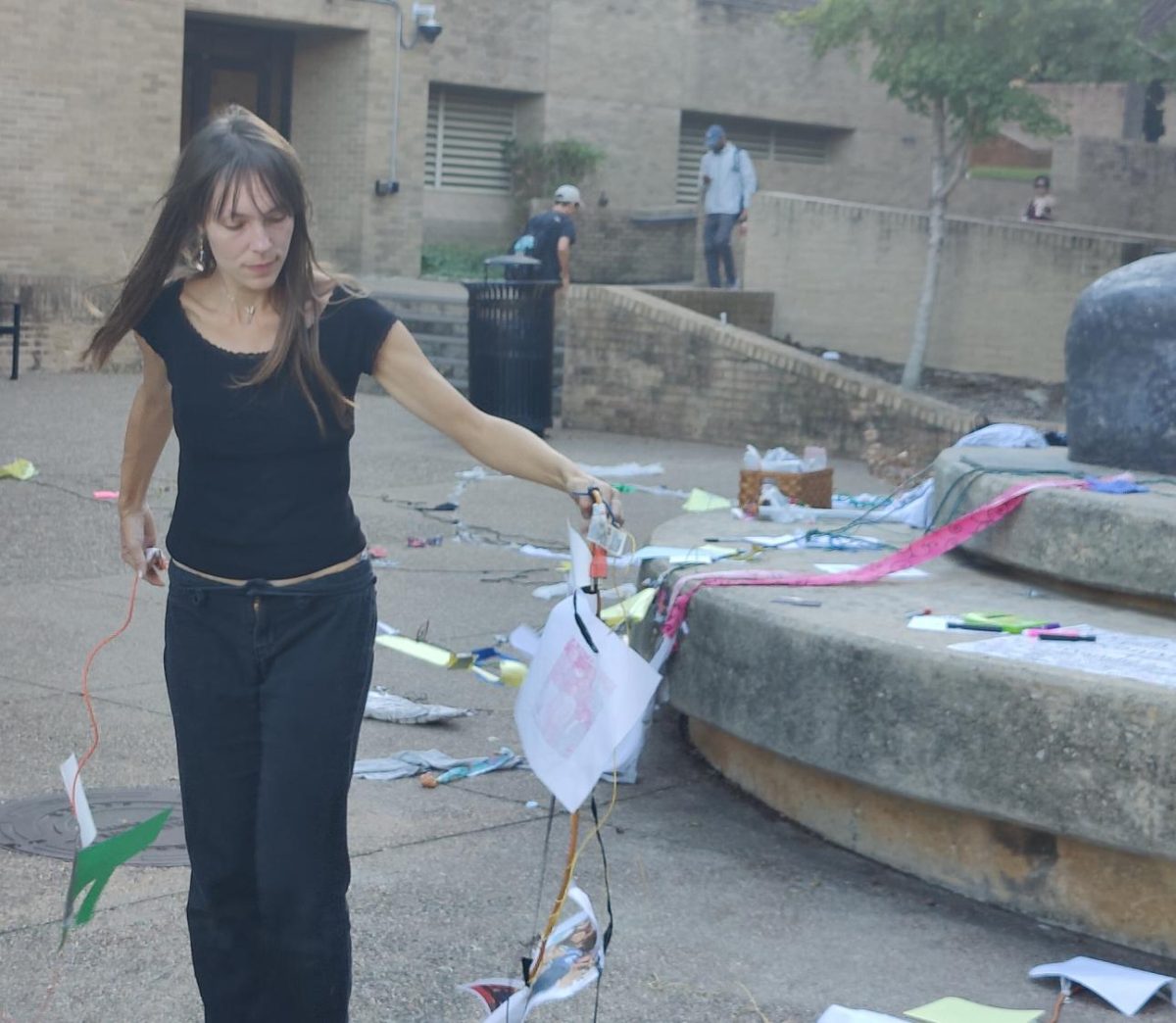
Images of Matthew McConaughey and Jessica Fox, tangles of hair and various trinkets surrounded The Stallions on one November afternoon.
Students diligently attached these items to nerve-like strings, which were tied to the statue from seven directions. While the resulting collage may have looked like a mess to others, to those students, it was a way to publicly express how they felt about recent political activity, protests and controversy.
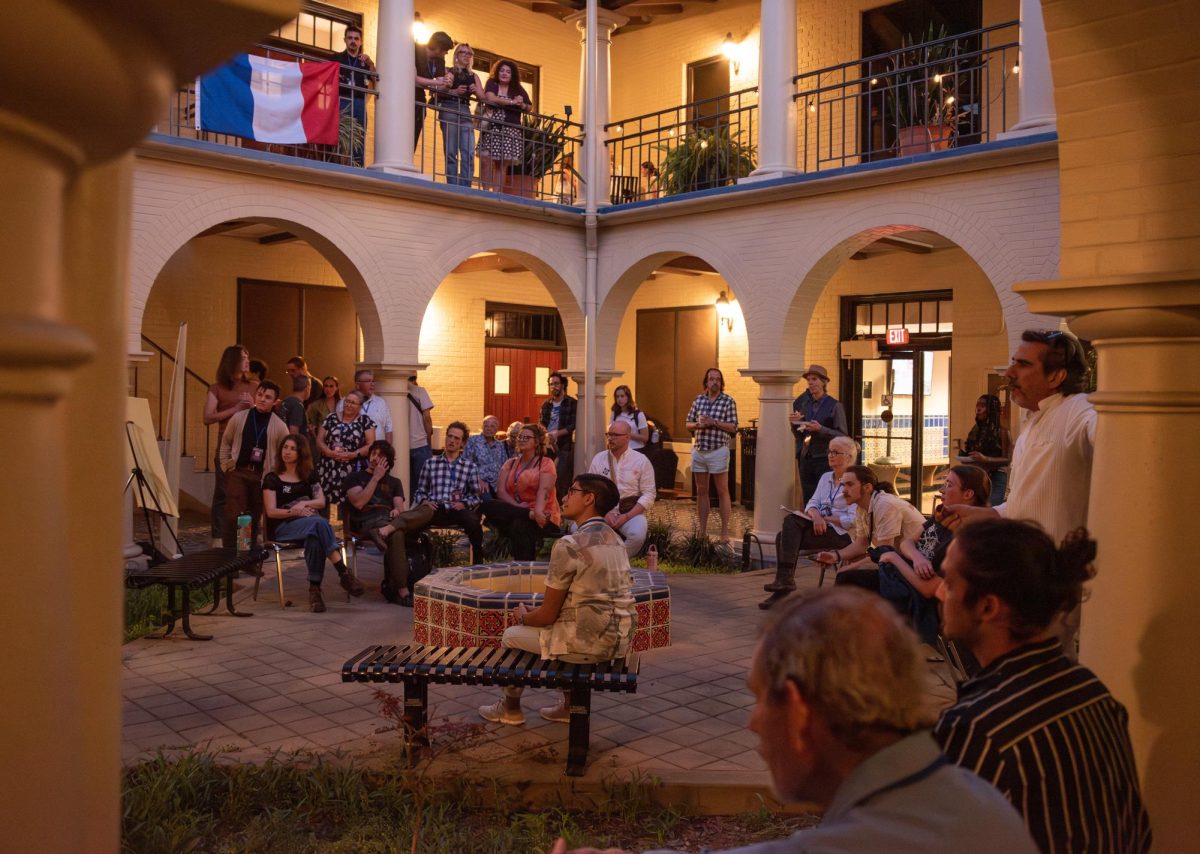
TXST Galleries invited Jessamyn Plotts, assistant professor of instruction at the School of Art and Design, and the American Communal Industries (ACI), a Central Texas-based art collective, to host the workshop. It was part of the gallery’s alumni exhibition “Letting the River Spill,” which allowed alumni artists to explore a practice they developed while in San Marcos.
For Plotts, this inspired the collage feedback loop, which she facilitated with her classes on Nov. 5. She utilized The Stallions statue due to its political activity. The workshop provided a chance for students to express their feelings, rather than tamping them down.

“[ACI and I] think art needs to be actively part of everything that goes on in society, not just kind of sequestered away in galleries and stuff like that, because artists are really good visual communicators,” Plotts said. “That’s what our strong suit is. So, we need to be taking that out into the community, out into society.”
Based on this idea, Plotts envisioned The Stallions as the eye of a figurative organism while Texas State’s buildings, study areas and offices were like organs. As a site where students could discuss and demonstrate information, she considered the statue the eye of the university system.
The seven strings represented the ways data is input into the “eye”: sense, observe, perceive, interpret, judge, fear and imagine. Each category accumulated information through drawings, writings, pictures and collage.
Plotts described the strings as how the consciousness in living beings takes in information with the senses, which turn into perceptions through observations. Once they have that information, they interpret it to form opinions, judgments, fears and imaginations. Anyone who wanted to participate could attach one or multiple items to the tendrils based on what a category meant to them.

The workshop caught the attention of many students who walked by. Plotts said some commented on the decorations from a distance, calling it “trash” or “beautiful,” while others directly asked her what was happening. Plotts appreciated the comments because they meant observers had an emotional reaction to the collage and were interpreting it. At some point, Plotts had to restart her explanation several times because more people wanted to know what the workshop meant.
“It’s really beautiful and amazing, and people don’t know how to respond to a thing because it means that they’re having a real experience with it,” Plotts said. “They’re not complacent, even if they don’t like it.”
David Henderson, philosophy junior, was walking across The Quad when he saw the collage. He added a small bracelet, a thin chain, a receipt and two pieces of cloth. Henderson said he never thought of The Stallions as an action-intensive statue until talking to Plotts.
“[Plotts] had a real good point on how the statue shows things stripped down to its more base nature, like the wildness of The Stallions and the stark lack of clothes on the people,” Henderson said. “I think, personally, it speaks towards a more natural, almost instinctual sort of implication.”

Some students wanted to place a wig, jewelry and cloth that formed a gag at the top of The Stallions. Plotts allowed them to, believing it was meaningful that she and other students were inspired and energized to take visual actions and were not prevented from doing so.
An hour into the workshop, TXST UPD spoke with Plotts regarding safety concerns with students climbing The Stallions. She directed the group to remove the items and detach the strings from the statue, having them surround its base instead. Plotts said she expected officers to arrive, as she has done work like this before, and the point was to test the limits of the university’s free speech area.
“And I did tell [the students], ‘We’ll go ahead and put stuff on there, and then they’ll tell us if we can’t,’ and I think that’s okay, and then it’s meaningful that they were asked to take it down,” Plotts said. “So, the institution gets worried when they start seeing things that go out of bounds, and they tell you what the limit is, and you can really see what the limit is.”

By the evening, Plotts directed her class to remove the collage from The Stallions and transport it to the Joann Cole Mitte building. One or two people held each string as the group walked in a single file line, accompanied by the collage’s sounds: paper swishing, leaves rustling and keys clinging like wind chimes.
Jazelle Oliva, pre-business freshman, participated in the workshop during Plotts’s last class. She said it only solidified the importance of the value of expression.
“I got that it’s always good to take a break and just express yourself because this is mainly just for people to stop, slow down and contribute whatever they think is valuable,” Oliva said.
Plotts spoke with Sarah Kleinman, TXST Galleries director, about draping the collage around “Letting the River Spill” before deciding on a more permanent location on the second floor outside the galleries and near an elevator. Since its installation, Plotts said the collage was well received from other faculty and students.
The collage is mostly the same from its creation aside from a few items that could not make it to the building, such as a bicycle that was attached to a tendril. While the collage is up indefinitely, Plotts hopes it can stay up until the spring, when she can lead a discussion about what she and her class did and the resulting work.
“The ideas that we were exploring will still be the same come spring, if not more relevant, to reflect on how we communicate on campus and be a little bit more discerning and willing to do different types of communication, maybe using art methods,” Plotts said. “All of that will still be relevant in the spring, so we may as well just leave it up as long as we can.”
To learn more about the collage feedback loop, visit Plotts’ website at https://www.jessamynplotts.com/general-8-1.