
San Marcos is experiencing a significant decrease in reported fentanyl related overdoses, according to 2022-25 data from SMPD.
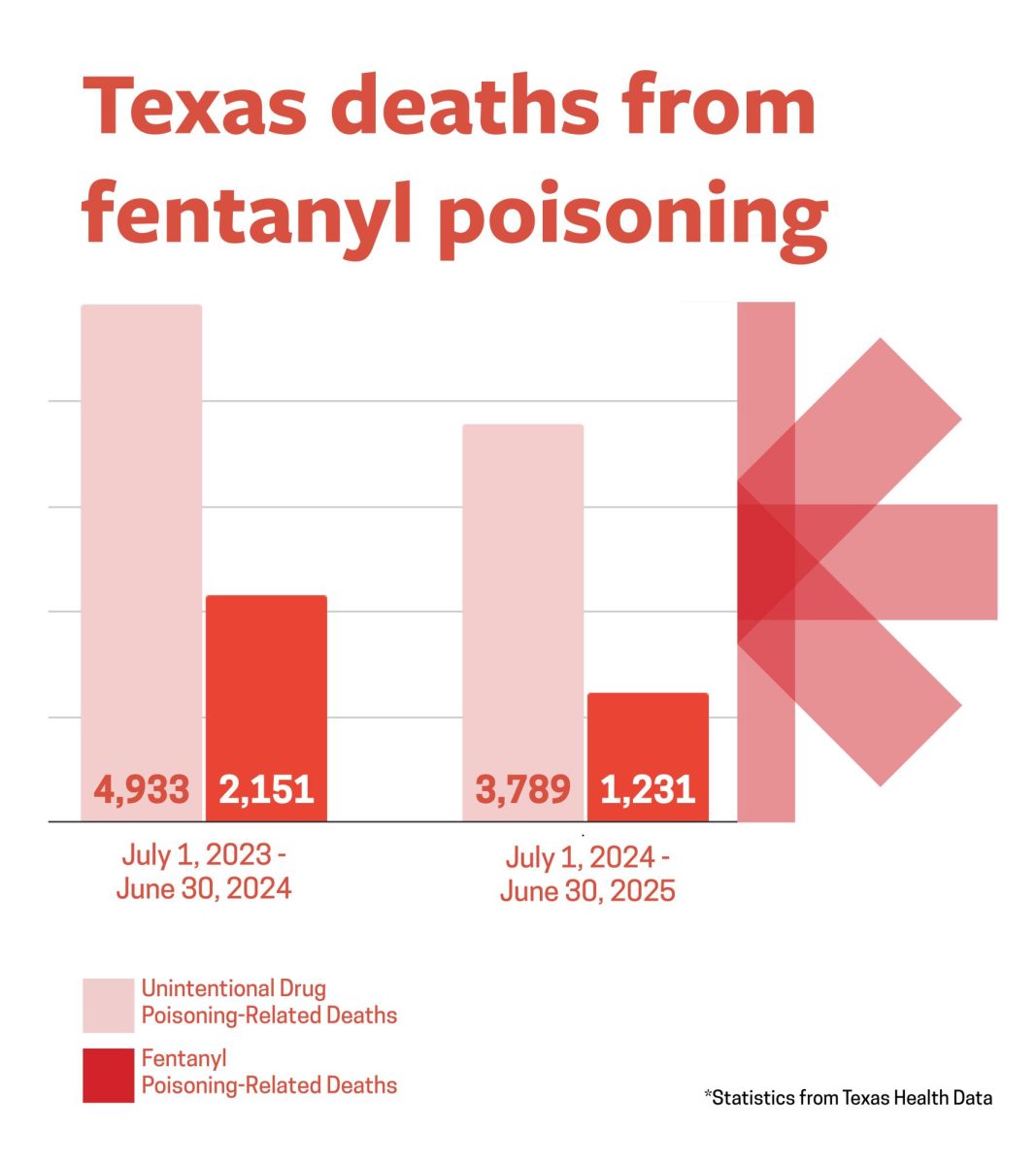
In Texas from July 7, 2023, to June 30, 2024, there were 2,151 fentanyl poisoning-related deaths. From the same reporting period in 2024 to 2025, there were only 1,231 reported deaths. This constituted a 42.8% decrease, according to Texas Health Data. This same downward trend is occurring in San Marcos, according to Russel Wilde, San Marcos Police Department’s Public Communications Specialist.
“I will say fentanyl overdoses/use is way down in 2025,” Wilde wrote in an email to The Star.
According to data provided by Wilde from August 2022 to January 2025, there were 31 documented overdoses in San Marcos, eight of which resulted in death.
Fentanyl is a synthetic opioid drug that is more potent than most drugs, with as little as 2 milligrams being enough to cause a fatal overdose. Fentanyl is often laced in other illegal drugs, such as cocaine, heroin, methamphetamine and counterfeit prescription pills. Often, individuals unknowingly consume fentanyl, leading to a life-threatening situation, according to the National Institute of Drug Abuse.
Hays County recently ranked among the top 15% in Texas counties for fentanyl overdoses and deaths. Hays County school districts are partnering with the Fentanyl Education Support Training Awareness program to educate those from sixth-12th grade on safety regarding unintentional fentanyl poisonings. The primary purpose of this program being to combat fentanyl poisoning within the community according to KVUE.
Researchers at Texas State are using the nearly 2 million dollar grant from the Substance Abuse and Mental Health Services Administration to help strengthen this program to help Hays County schools organize educational programs relating to fentanyl poisoning, according to the Texas State Newsroom.
Seth Watts, an assistant professor of criminal justice and criminology, said there are three possible reasons as to why there is a decrease in reported cases of fentanyl overdose deaths. Watts said fewer risky users of opioids in the population due to high-risk usage eventually leading to death, a higher distribution of Narcan and opioids becoming less potent are possible reasons leading to a decrease.
Narcan, or Naloxone, is a drug used for opioid overdose. It is typically administered through a nasal spray or an injection, according to the CDC. Watts said Narcan is an effective “opioid antagonist” that latches onto opioid receptors and knocks off the opioid, allowing the respiratory system to regain function.
“There’s a lot of good data coming out of the [Center for Disease Control]. Looking at regions, states, counties and just at the national level, what we see is that there has been a decrease in opioid related deaths,” Watts said.
Watts said when an overdose occurs, the most effective way to combat the effects is through Naloxone administration.
Lucia Summers, criminal justice and criminology professor, said an increase in the number of non-fatal overdoses sometimes can occur because Narcan lowers the fatality of overdoses, however, not the number of overdoses themselves.
“You can go for a drink in a bar, and there’s Narcan in the restroom,” Summers said. “It’s very easily available. The police are now carrying [Narcan] as well.”
Summers also said legislation passed in Texas may have affected declining rates of fatal overdoses.
The series of legislation, House Bill 6, 3144, 3908, and Senate Bill 867 was passed to prosecute deaths from fentanyl as murder, provide death certificates that list fentanyl poisoning as the cause of death and distribute Narcan on a larger scale, according to the Office of the Texas Governor. This legislation was passed during the 88th Regular Legislative Session in Texas.
Watts said most overdoses are not fatal, and preparation is the most important aspect of responding to an overdose. Watts said CPR does not work for an overdose of opioids, or is futile without medical help or administering Naloxone.
Narcan is available in all 50 states and is accessible without a prescription. Administering Naloxone should be the first step if someone is experiencing an overdose, and 911 should be notified immediately after. If you are not sure what to do in the case of an overdose, refer to the CDC guide.
“If there’s an overdose, and there’s a call for service, then you can administer it, and then it’s going to turn into a non-fatal overdose,” Summers said.
Texas State offers a series of programs for those struggling with drug addiction. This includes programs like the Student Recovery Alliance, which offers support to students at any level of recovery.
As part of the Texas State Naloxone Distribution Program, there are three Naloxone distribution stations on campus. For information on where these services are available and where Naloxone is distributed on campus, refer to the University Health Center.