
The Texas State University Police Department initiated a campus program, hiring students to monitor around 900 cameras on the San Marcos and Round Rock campuses.
“Project Overwatch” will hire students to the UPD dispatch center to observe cameras for the full duration of their shift. Student workers will be on the lookout for incidents so they can directly report them to a dispatcher, without UPD having to wait for a call to come in.
The program will not only provide student employment, but could help ensure quicker response time, according to Cat Hoyt, alternative program coordinator for UPD.
“If we have a student overwatcher who’s sitting there watching a camera, [that is] in The Quad, and they see something happen, they can immediately turn to the dispatcher who they are sitting with and say ‘Hey, I just saw this,’ so we’re not having to wait for a call to come in.” Hoyt said.
Employees, called Public Safety Officers (PSOs), are tasked with providing real-time information to officers and dispatchers, watching out for any suspicious or criminal activity. In addition, they will identify dangerous ground hazards, according to Tatiana Salazar, a public information officer with the Texas State Newsroom.
The program is estimated to be fully staffed for the fall 2026 semester. Cameras at Texas State are currently watched 24/7 by UPD employees, on top of their current duties, whereas the student employees will be solely responsible for watching the cameras, according to Hoyt.
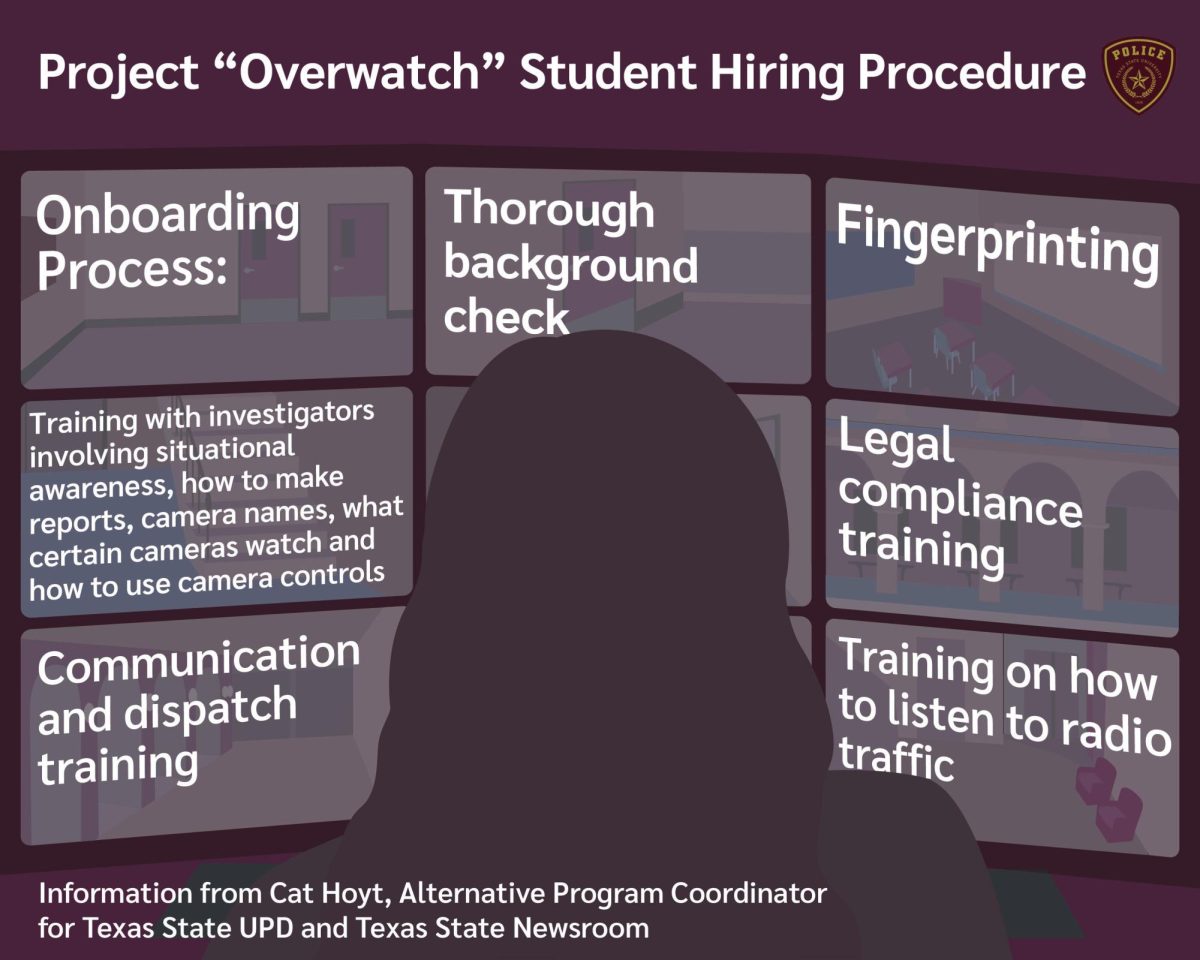
Hoyt said no experience or previous employment is required. Upon hiring, employees will undergo a thorough background check and fingerprinting.
“We’re looking for any sort of Texas State student that has an initiative and a want to help out fellow students and help protect campus,” Hoyt said.
Students will also train with a UPD investigator. Training will include situational awareness, how to make reports, where cameras are located and how to use cameras with controls.
UPD Chief Matthew Carmichael said in a recent Campus Safety Committee meeting that as more students are hired, the program is on its way to being fully monitored 24/7. Hoyt confirmed that because of the program, more cameras will be monitored.
“[PSOs] aren’t having to [go] back and forth of doing one thing, to this thing, to [those] sort of [other duties],” Hoyt said.
Michael Faber, an associate professor of political science, said students in his Politics of Dystopia class critiqued the project during class discussion.
“[Project Overwatch] seemed to fit in with this general theme that we were discussing about government surveillance and the idea of government watching its people at all times on a very local level and with a very personal connection,” Faber said.
Faber said the class generally disliked the idea of the project. One student mentioned the Panopticon, a design for a prison where someone may think they are constantly being watched, despite not having enough staffing to watch every person.
“[The program] probably does actually increase safety, but that perception, especially against the backdrop of reading 1984, especially against the backdrop of a U.S. government that really over the entire lives of these students, has been increasing surveillance tendencies, it’s very easy for them to assume that there may be something nefarious going on here,” Faber said.
According to Lucia Summers, a professor in the school of criminal justice and criminology, active monitoring of CCTV cameras in a systematic review is more effective than passive monitoring, which is known to show significant and moderate reductions in crime.
Summers said all police data is monitored and tracked, and that students would not receive jobs such as a dispatcher without appropriate training and being familiar with policies.
“Any law enforcement agency will have general orders on their own organizational policy. So that’s something that’s not ignored,” Summers said.
In public locations, there is no reasonable expectation of privacy, according to Summers.
“[CCTV] Cameras [are] very much what we’re used to. There are other countries, for example, in the [United Kingdom], they have so many CCTV cameras all over the place, and the police use them to solve crimes,” Summers said. “The murder solvability rate is incredibly high because they have that tool and they have access to information that maybe other places don’t have.”
Salazar reported that as of March 24, the program had three PSOs. Currently, they have already assisted around campus by ensuring the cameras operate properly and ensuring maintenance issues were up to date.