

Among the warm sun and soft winds, Juan Leyva stood behind Spring Lake. A steady drumbeat played as Leyva blew into a conch shell, and an audience turned to honor each of the seven directions in Coahuiltecan: ota-ume, se’ta, we’fta, haya’mta, Uxuāl Xanāl, Tāp Tāi and naxasāl,
“We ask that you send prayers and good thoughts to the water, to the ancestors that are here, wherever you come from and who you represent and who you are connected with,” Leyva, an Indigenous Cultures Institute (ICI) volunteer, said.
The Sacred Springs Powwow, which occurred on Oct. 4-5 this year, honored the Native ancestors who lived and died around the area, bringing together the art, tradition and languages of many Native cultures for an annual, two-day event. It began in 1995 when musician Lucky Tomblin first produced it in San Marcos.
This year marked the 15th anniversary since the ICI asked permission from Tomblin and his wife to reinstate the powwow as an annual event. Since then, it grew into a large event filled with traditional drumming and dancing, food and craft vendors, and educational programs.
Each powwow begins with a blessing at the shores of the Sacred Springs at Spring Lake. Whenever the ICI holds an event, it asks permission of the elements to be there and for blessings and guidance for what it is doing.
The seven directions are east, south, west, north, Father Sky, Mother Earth and “my heart.” Leyva said east and west represent the sun rising and setting, but north and south differ depending on the culture. Father Sky is often associated with the heavens, and they give thanks to Mother Earth for what she provides.
“There’s this story that the creator of the cosmos created all things and at the very end said, ‘I have the spirit of the people, but I don’t know where to put it,'” Leyva said. “Then the idea came where the creator said, ‘I know where I’ll put it. I’ll put it inside of the people because that’s the last place that they’ll look.'”
Sylvia Jean, retired administrative associate at UT Austin, has participated in many communities and powwows for over 35 years and danced in competitions. She offered a blessing during the ceremony to for those nearby to walk in balance and harmony. Jean laid her Pendleton blanket designed with a medicine wheel on it, which represents the alignment and continuous interaction of the physical, emotion, mental and spiritual realities. She thanked the waters before asking those around her to visualize the story of the Coahuiltecan people extracting the waters.
“I want to leave a thought in your mind to think about being some of the first discoverers to walk this way along the heat and then finding this beautiful geyser of water … That must have been a miracle for people who have been walking long distances,” Jean said.
Mario Garza, chair of the ICI’s board of elders, recalls a mural called the White Shaman Panel near Comstock, TX, shows the four sacred springs — Barton, San Marcos, Comal and San Antonio — and the creation story of the Miakan-Garza Band of the Coahuiltecan people over 14,000 years ago.
“The significance of the springs here, and that’s why it’s called the sacred springs, is because we consider this is where we came out into this world,” Garza said.
The Sacred Springs Powwow doubled the prize money for this year’s dance competition, offering $25,000 in cash prizes and encouraging over 100 Native American dancers to showcase their skills and regalia.
ICI projected this year’s powwow to have over 8,000 people in attendance, an increase compared to more than 7,000 the previous year. The increase in numbers reinforced the idea of people wanting to learn more about and support the cultures.
“Toward the springs, we haven’t noticed that many things, but we noticed more people are informed about our creation story, more people are informed about our history, our relationship to the springs here and more people are learning the reason for calling it the sacred springs, and that’s because it’s our most sacred site,” Garza said.
-
Coahuiltecan people give thanks to father sky durring the Sacred Springs Powwow opening blessing, Sunday, Oct. 5, 2025, at the Meadows Center.

-
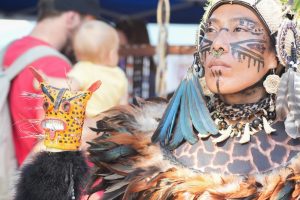
Iztli Parra and her jaguar buddy survey the powwow vendor tents on the lawn at the Sacred Springs Powwow, Saturday, Oct. 4, 2025, at The Meadows Center.
-
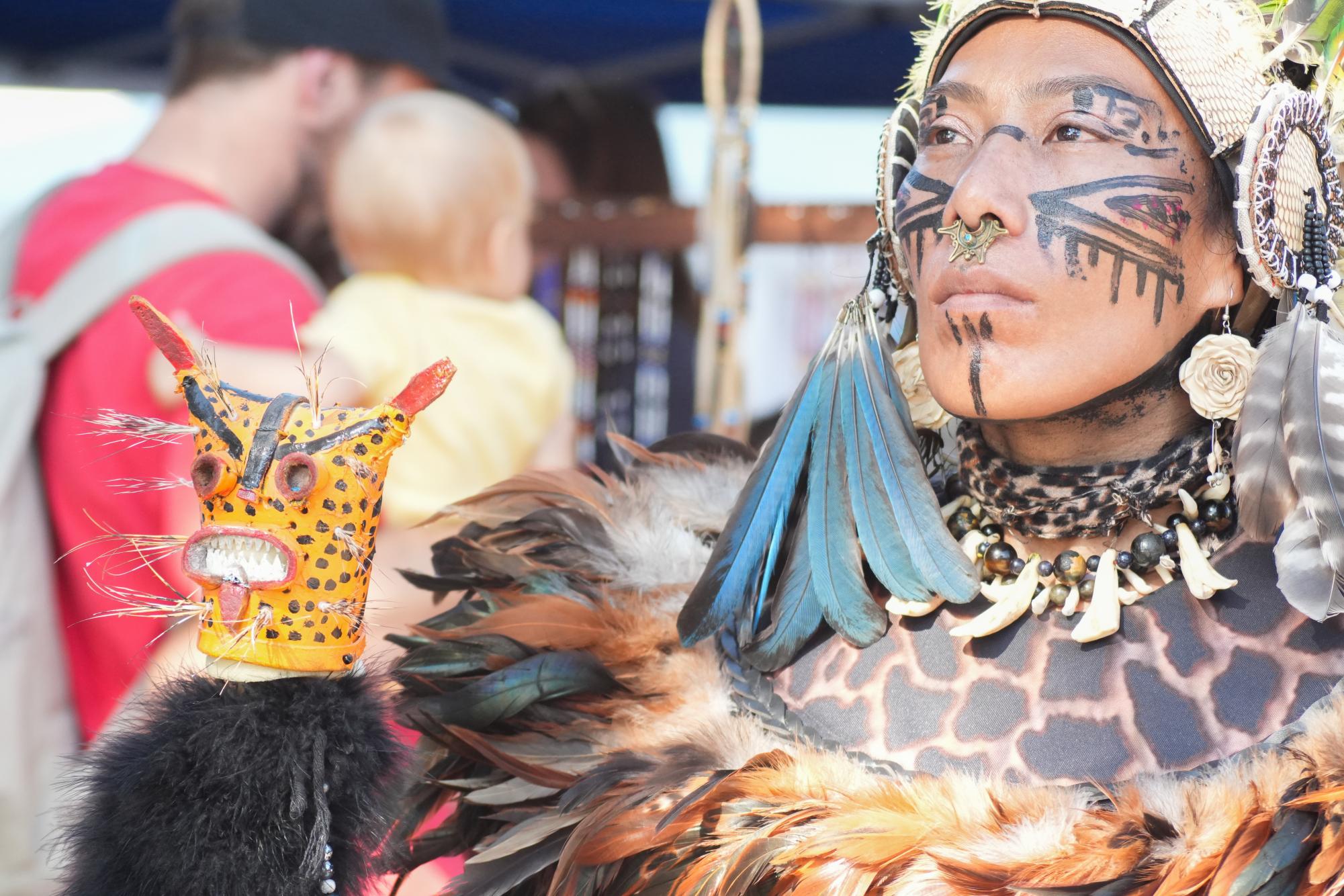
Lipan Apache tribe member Enrique Josekuauhtli performs his Mexica Nauhuatl dance for the Aztec Exhibition in the Sacred Springs Arena Tent at the Meadows Center, Saturday, Oct. 4, 2025.

-
An Aztec dancer enters during in full regalia during the grand entrance at the Sacred Spring Powwow, Saturday, Oct. 4, 2025, at the Meadows Center.

-
A dancer during “Aztec Exhibition – Danza” at the Sacred Springs Powwow, Sunday, Oct. 5, 2025, at the Meadows Center.

-
Oklahoman Feather Dancers participate in the dancer grand entry at the Sacred Springs Powwow, Sunday, Oct. 4, 2025 at The Meadows Center. The Oklahoma Feather Dance, also known as the “Fancy Dance,” is a popular dance at powwows.